
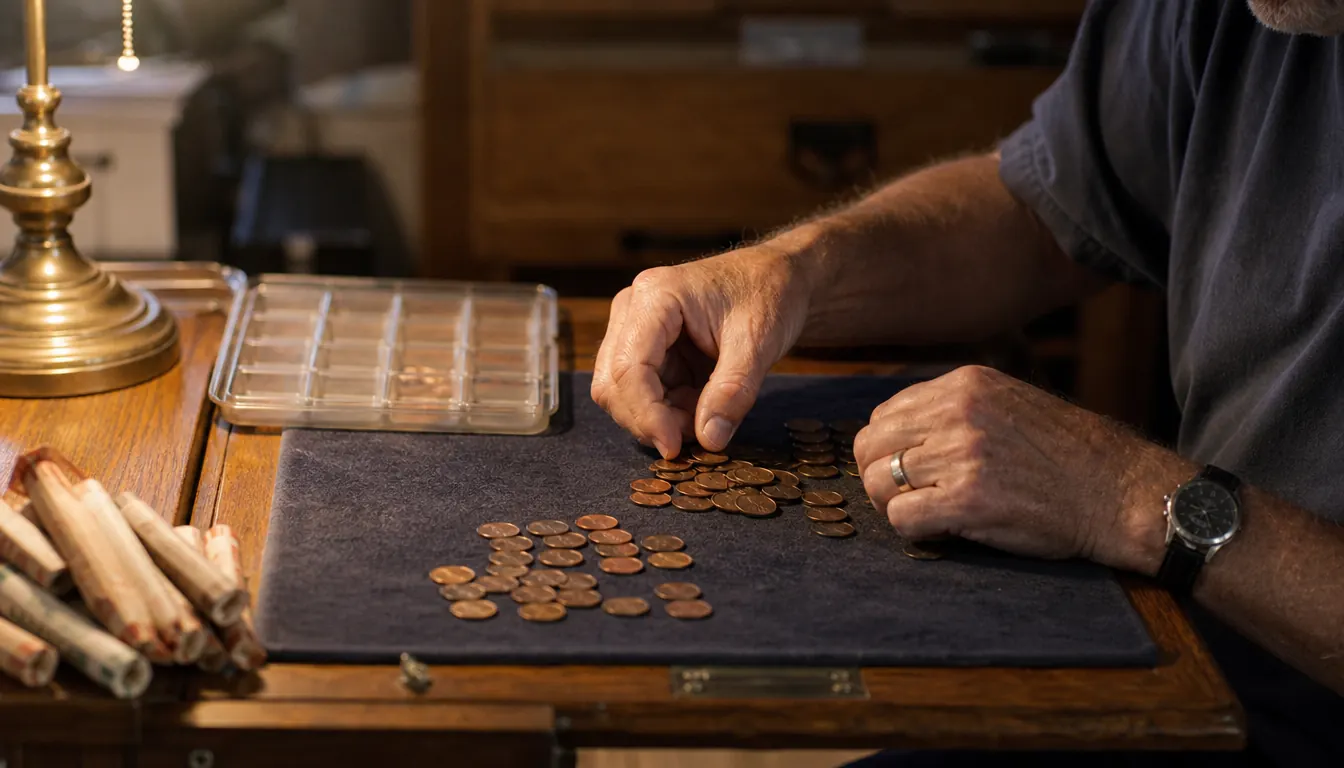
Every collector I know owns at least one Whitman folder, and most of them own a shelf of them. Mine live on the plank above the folding oak desk in the coin room, and the Lincoln Cents #3 is the one that comes down most often, because 1975 through 2013 is exactly the stretch that turns up loose in pocket change, in a drawer at the bottom of a dresser, and in the coffee can somebody's grandfather left behind. That is the pitch you have already read a dozen times in a dozen places. Here is the part the listing leaves out, written by somebody who has filled this same folder three times and watched a ten year old fill a fourth.
I have been sorting Lincoln cents since I was twelve, when my grandfather handed me a coffee can of mostly wheat pennies, and I have been at it seriously for the last nine years since I retired from teaching shop. The copy sitting in front of me right now is the one I bought new and finished over two winters of roll hunting. I am not going to tell you the Whitman folder is perfect, because it is not, and I am not going to tell you it will protect a coin, because it will not do that either. What I can tell you is precisely which parts of it earn their place on the shelf and which parts will eventually send you looking for something else.
The Quick Verdict
The simplest honest way to get 1975 through 2013 out of a coffee can and into order. Treat it as a sorting tool that lives on a shelf, not as storage, and it will outlast your interest in the date range.
Amazon Check Today's Price →Get the cents out of the coffee can this weekend instead of next spring
Whitman has been printing this same folder since 1987 and the layout has barely moved, which is either laziness or proof that it works. After three copies I am fairly sure it is proof.
Amazon Check Today's Price on Amazon →How I Ended Up With Three of These
The first copy came out of a dealer's junk box at a regional show outside Toledo, already half full of circulated cents that somebody had pressed in and then abandoned. I finished that one over about two years of roll hunting. The second I bought new and filled again, because my first pass had been sloppy about which coins actually deserved a spot. The third belongs to my grandson Tyler, who is ten and who sorts pocket change with me on Sunday afternoons. His is the copy that taught me the most, because a ten year old does not handle cardboard gently and does not care about your feelings.
What Tyler taught me is that this folder rewards patience and punishes hurry. A coin has to be seated flat before you press it, and if it is not, the opening takes the damage rather than the coin. He forced two of them before he found the rhythm. Both times the folder survived and both times that opening came up a little looser, which is the trade you make when the pages are cardboard. Nothing tore. Nothing separated. But a slot that has been forced is a slot that will not hold as snugly, and there is no fixing it short of starting a fresh folder.
The physical object is exactly what the listing says it is: 7.75 by 5.93 by 0.28 inches and 3.53 ounces. That is a thin, light thing with roughly the footprint of a hardback book, and it slides onto a shelf between two others without demanding space of its own. It lies flat. It does not sag or curl at the corners the way heavier binders sometimes do. That sounds like nothing at all until you have owned a folder that did sag, and then it sounds like the main reason to buy this one.
What the Cardboard Gets Right
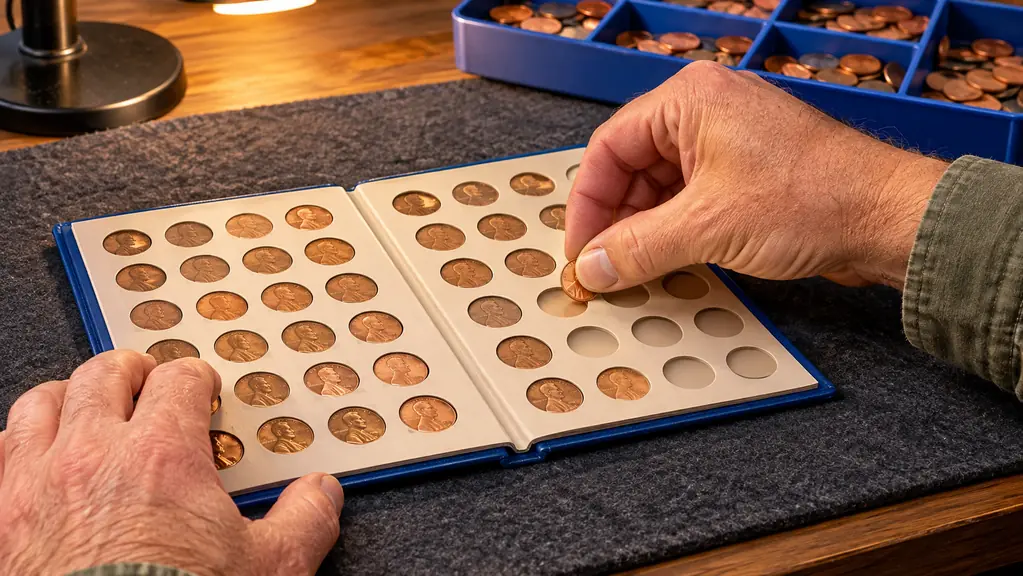
The years are printed where you can actually read them, and the order follows the order the coins were issued, so filling the folder is a mechanical act rather than a research project. For a beginner that is worth more than every other feature combined. You do not need a catalog open beside you. You do not need to know which Philadelphia issues are the harder ones in the run. You need to find the year and press the coin, and the folder handles the rest of the thinking for you.
The second thing it gets right is that it is honest about what it is. The listing files this as a three page book with an ISBN, a publisher and a publication date of July 1, 1987. That tells you the whole story of the product in one line. It is a printed book with openings punched for coins, and it has been the same printed book for close to forty years because the idea works and nobody has improved on it enough to matter. There is no marketing layer between you and the object.
The third thing is the one I use every single week. A folder puts an entire date range in front of you at once, so a box of cents becomes one sorting pass instead of an evening of flipping coins under a lamp. When I am finished, the gaps tell me what to hunt for. See the gap, hunt the gap, fill the gap. That loop is the whole reason folders exist, and this one runs it cleanly from 1975 all the way through 2013 without a single confusing page.
One more thing it gets right, and this matters more every year: the printing is large enough to read without leaning in. I am sixty seven and I wear glasses for close work, and I can find a year in this folder under the desk lamp without picking the folder up. Half the reference books on my shelf cannot say that, and several of them cost more than this folder does. Small thing. It stops being small around the time your arms get too short.
Where It Quietly Fails You
Once a coin is pressed into an opening, you are looking at one face of it and nothing else. The reverse is hidden against the board until you pry the coin back out, and prying a coin back out is the exact handling you were trying to avoid in the first place. If your interest runs to varieties, and Lincoln cents in this range are full of them, this is the wrong tool for studying them. An album with removable pages is the right tool, and it is built differently for a reason that has nothing to do with marketing.
Once a coin is pressed into the opening, the reverse is gone until you pry it back out, and prying is the handling you were trying to avoid.
The second failure is exposure. Cardboard is cardboard. It is not sealed and it does not keep an Ohio July away from copper. Nine years in a spare bedroom with a dehumidifier running has left my folders with a slight wave to the pages, and one of them carries a faint stain on the corner from a window I should not have left open that summer. The coins came through fine. The folder did not, and a folder that has taken on moisture is now sitting in contact with your coins, which is not the arrangement you want over a long stretch of years.
The third failure is the one that irritates me as a man who likes systems. There is nowhere on the page to write. No grade, no note about where a coin came from, no record of the Sunday Tyler found a 1983 in his own pocket change and wanted to remember it. My grandfather's cents arrived with stories attached and this folder has no place to keep them, so the stories go into a notebook on the shelf and the two get separated the first time somebody tidies the coin room.
The 1982 Problem, and 2009
The folder is laid out by year, which makes sense right up until the years the mint changed its mind mid stream. In my copy, 1982 gets one place to sit, and 1982 pennies come both in copper and in zinc, and both are common enough that you will be holding one of each in the same handful on the same afternoon. You pick one for the folder and the other goes into a tube in the drawer. Same story in 2009, when four different reverses were struck for the Lincoln bicentennial and a single opening means three of them live somewhere else entirely.
I do not think that is a defect exactly. It is a layout decision made when this book was first printed and never revisited, and revisiting it would mean reprinting a product that already moves steadily on its own. But you should know it going in rather than discovering it halfway through a roll of 1982. If having all four 2009 reverses side by side is important to you, buy the album instead and save yourself the second purchase six months from now.
Handling, and Why the Folder Makes It Harder
I wear nitrile gloves for anything uncirculated and I hold everything else by the rim, and I will say plainly that a folder makes that discipline harder than an album does. To seat a coin you have to press on it. There is no way to press on a coin without touching a face, and the face you touch is the one you will be looking at for the next thirty years. On circulated cents that is a rounding error. On a nice red 1975 it is not, and no folder in the world changes that arithmetic.
The workaround is simple and I recommend it to everybody who asks me at the club meeting. Sort first, in a small plastic tray on a felt pad, and only press the keeper into the folder once you are certain it is the keeper. I keep a tray on the desk for exactly this and I do not open a folder until the sorting is finished. That one habit has saved me more grief than any product I have ever bought, and it costs nothing but a little patience on a Sunday.

The Two Complaints I Hear Most
At the monthly club meeting the same two complaints come up about this folder. The first is that it does not hold every variety, which is true and which nobody at Whitman ever claimed otherwise. The second is that coins fall out when the folder is turned upside down, and to that I say: stop turning the folder upside down. Neither complaint is really about the folder. Both are about expecting a printed book to behave like a locking case, and it was never going to do that.
What I hear less often, and what I think is the more useful warning, is that people buy the folder and then treat it as the end of the job. The folder is the beginning. Getting the cents into it takes a winter of evenings. Understanding what you actually have takes considerably longer, and no amount of cardboard does that part for you. Buy it as a starting line and you will be happy with it for years.
How It Has Held Up Over Nine Years
My oldest copy is past twenty years now. The corners of the cover have softened, the printing down the spine has worn to the point where you have to tilt it toward the lamp, and the pages carry a slight bow. Nothing has torn. Nothing has separated. The cents that went in first are the same cents that sit in there today, and they look the way they looked when I pressed them in, which is the only durability question that matters to me at this point in the hobby.
The new copies are the same object as the old one. Same thickness in the hand, same weight, same give when you press a coin into an opening. I checked because I expected the opposite. A printed product that has been in continuous production since 1987 usually gets thinner and lighter somewhere along the way, and if that happened here I genuinely cannot see it. The listing carries a 4.8 across nearly four thousand reviews, and after handling three of these I understand why the complaints are about layout rather than construction.
What I Liked
- Covers 1975 through 2013 on one pass, so a box of cents becomes one sorting session instead of an evening of flipping
- Thin and light at 0.28 inches and 3.53 ounces, so it shelves flat between other books without needing room of its own
- Year printing is large enough to read under a desk lamp without picking the folder up
- Same physical product for close to four decades, which is its own kind of quality control
- Simple enough that a ten year old can fill one without a catalog open beside him
Where It Falls Short
- One face only. The reverse is hidden until you pry the coin back out
- Nowhere on the page to write a grade, a source, or a note about where a coin came from
- Cardboard takes on moisture and then sits in contact with your coins for years
- One opening per year forces a choice on 1982 and again on 2009
- Seating a coin means touching a face, which is the handling you were trying to avoid
Who This Is For
This folder is for the collector with a pile of twentieth century cents and no system for them. It is for the person who inherited a coffee can, the way I did at twelve, and wants to see what is actually in it without spending a weekend with a catalog. It is for a kid like Tyler, who will learn more about dates and mint marks pushing coins into cardboard on a Sunday afternoon than he would from any video on a screen. And it is for the collector who understands the difference between sorting and storing, and who has a shelf in a dry room to put it on.
Who Should Skip It
Skip it if your coins are uncirculated and you intend to keep them that way, because pressing a coin into an opening is handling no matter how clean your hands are. Skip it if you are chasing varieties or the 1982 composition split, since you will be pulling coins back out constantly and leaving fingerprints where you would rather not. Skip it if the room where you keep your collection runs damp and you have no plans to change that. And skip it if you want your coins to look like a collection rather than homework, because this is unambiguously homework.
None of that is meant to talk you out of the folder. It is the tool I reach for most, three copies in, and I will buy a fourth without complaint when Tyler wears his out. What I want is for you to buy it knowing what it does. It takes a mess and gives it order, quickly and for very little, in a form you can hand to a child. The storage argument is a separate question and a separate purchase, and you should make it separately rather than expecting cardboard to do a job it was never built for.
If the coffee can is still on the shelf, this is where to start
Three copies in, this is still the folder I hand to anyone who asks how to begin with Lincoln cents. Read the four cautions above, then fill one anyway. Order beats hesitation every time.
Amazon Check Today's Price on Amazon →