

The first coin club meeting I ever brought a price guide to, I felt like I was walking in with an answer key. That was nine years ago, and the book was a borrowed older edition that smelled like a basement. By the end of the night three members had asked to see it. This spring I finally replaced it with the 2026 Red Book from Whitman, the 79th edition, 484 pages, published in April 2025. It has sat open on the folding oak desk in my coin room most weeks since. I carried it to two regional shows. I propped it against the sugar bowl at the kitchen table while my grandson Tyler sorted a pile of pocket change beside me. It is the most-used thing in that room that is not a lamp.
Let me be clear about what this book is before I say anything else about it. A guide book does not improve a coin. It will not make a worn 1920s cent worth more than it was worth before you opened the cover, and it will not tell you that you have been sitting on a fortune. What it does is end the guessing. For a long time I guessed. I guessed at mintage figures. I guessed at which dates in a series were the ones worth setting aside in a flip. I guessed at how the coin in my hand compared to the ones a dealer had laid out under his glass. Guessing is fine right up until somebody asks you a question.
The Quick Verdict
The reference I reach for first and the one I would put in a new collector's hands. It will not grade your coin for you, and its values are a snapshot rather than a quote.
Amazon Check Today's Price →The reference that stays open on my desk instead of closed on a shelf
484 pages, 79th edition, published April 2025, covering United States coins from half cents through modern bullion. If you are tired of guessing at dates and mintages, this is where you stop.
Amazon Check Today's Price on Amazon →How I've Used It
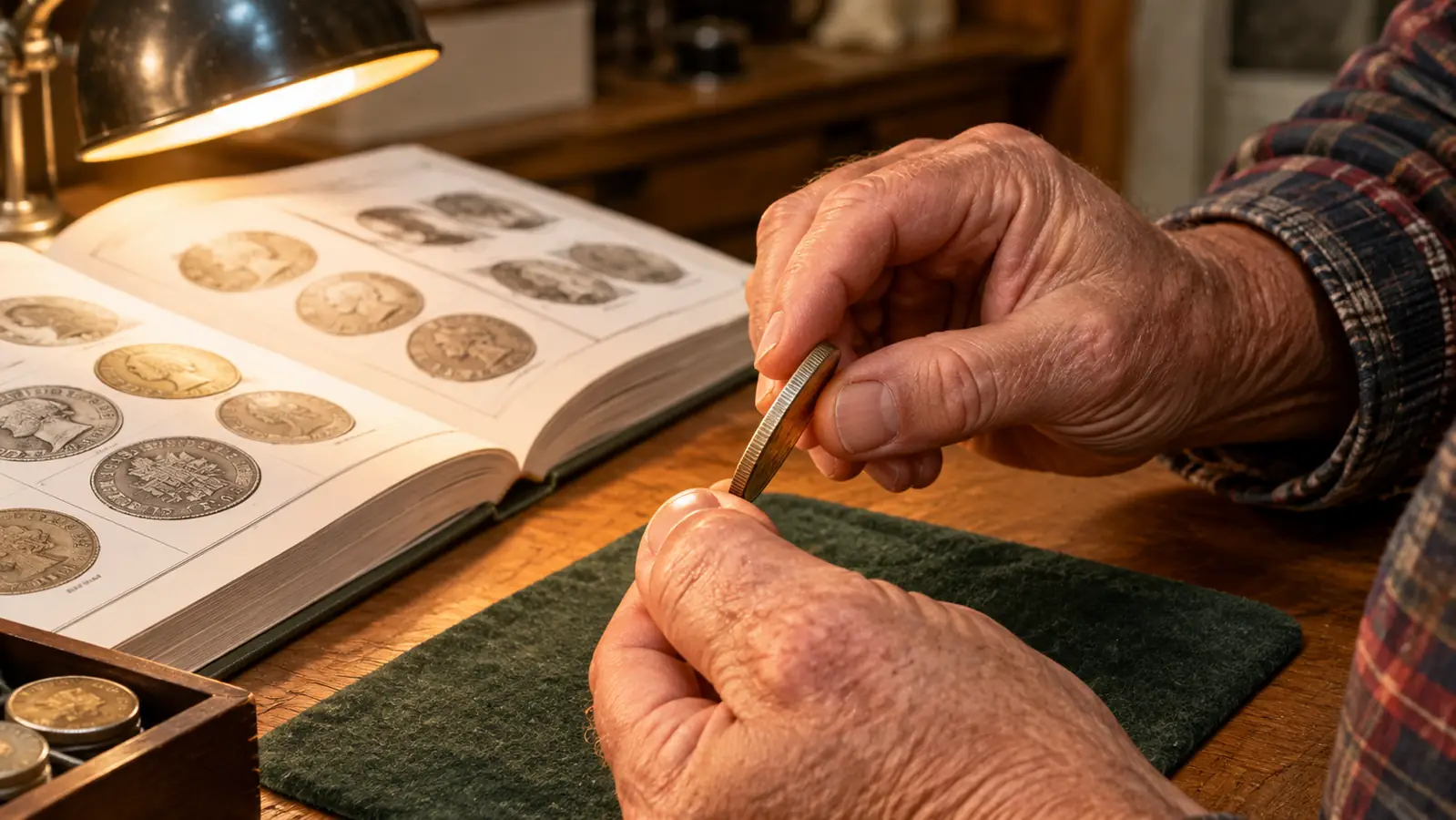
My routine has not changed much in nine years. Sunday afternoon I sit down at the oak desk with a felt pad, a small plastic tray, and whatever came home with me that week. The lamp goes on. The cotton gloves come out for anything uncirculated, because I would rather look silly than put a thumbprint on a coin. The book goes to my left, open, because I learned early that closing it between coins is how you stop using it. When I bring home a roll of quarters from the bank I go through them by date and mint mark first and look up only the ones I do not recognize. Twenty minutes, start to finish. The same pass on a computer screen takes an hour and I get distracted twice.
The bigger change is at shows. At a regional show last fall I stood at a dealer's table with a partial set of Washington quarters I have been filling for years. He quoted a number for the group. Instead of nodding, I set the book on the corner of his mat and looked up three of the dates. Two matched what he said. The third did not, and it turned out he had read the mint mark wrong in the low light of the hall. We both leaned in. Nobody was trying to cheat anybody, and that is exactly the point. A reference you can hold lets two people check the same fact at the same time, out loud, without anybody losing face.
The kitchen table use is different and honestly it is my favorite. Tyler is ten, which sits right at the reading age the publisher prints on the book, eight and up. He sorts pocket change into stacks by denomination and then I give him a year and ask him to find the mint mark. He is not learning to grade coins. He is learning that a question has an answer and that the answer lives in a book and not on a phone. Sunday before last he found a 1943 steel cent in a jar of my wife Carol's spare change and looked it up himself before he said a word to me. That is the whole exercise working.
One small thing I did not expect. The book has gotten heavier to me in a year, not lighter, and I have started leaving it in the coin room rather than carrying it out to the living room. That is not the book's fault. It is one point six five pounds and I am sixty seven. If you plan to haul it around, plan on a bag with a wide strap.
What 484 Pages Actually Gets You
The book is organized the way a collector thinks, by denomination, and then by series within that denomination, from half cents up through modern bullion. Each series gets its own run of dates and mint marks, with mintage figures, notes about which varieties exist, and values listed across a spread of conditions. It is not a novel and it is not meant to be read front to back, though I did read the first sixty pages straight through the week it arrived, mostly to see what had changed since the edition I had been borrowing.
Physically it is a working book and not a shelf ornament. Nine by six by one and three tenths inches. One point six five pounds. That weight matters more than it sounds. It is heavy enough to stay flat when you open it on a desk, which is what you want when you have a coin in one hand and nothing free to hold a page down. It fits in the outside pocket of the canvas field bag I take to shows, though the bag hangs crooked when it is in there. I have already creased the spine. I do not mind. A reference book with a clean spine is a reference book nobody opened.
The navigation is the part I would praise if I were writing for other people my age. Whitman has kept the same order from edition to edition, so once you know where the Jefferson nickels live you know where they will live in the next one too. There is an index, and the series headers are printed where you can find one with a thumb. That sounds like nothing. It saves real time at a table when somebody is waiting on you.
It does not settle opinions. It settles facts, and at a dealer table the facts are the part that holds up.
The Grading Chapters Are Where I Keep Landing
The part I return to most is not the price columns. It is the front of the book, the sections on how coins are made and how condition is described. I have been at this since my grandfather left me a coffee can of wheat pennies and old nickels when I was twelve, and I still get sloppy about the difference between a coin that is genuinely worn and one that was struck weakly to begin with. The book lays the terms out plainly enough that I can read a description, then look at the coin under the lamp, and see whether it fits.
One habit I picked up from those pages: I look at the coin first and form a plain description in my own words before I open to the listing. If I read the listing first, I find what I expect to find. Doing it in that order has kept me honest with myself more than once, including on a 1931 nickel I had been quietly proud of for years and which turned out to be exactly what it looked like and nothing more. That was a useful afternoon. It cost me a little pride and saved me from repeating the mistake to somebody who would have known better.
The Price Columns, Honestly
The values are the reason most people buy the book and the part I trust least, which is not a criticism of the book. Whitman publishes in April. By the time I am standing in a show hall in October, some of those numbers feel stale and a few are plainly behind. That is what an annual reference is. If you need a number for a specific coin on a specific afternoon, the book gives you a range and a starting point for the conversation. It does not give you a settlement.
Where the values earn their keep is scale. Before I had a guide I had no feel for how a coin sat against its neighbors in a series. Now when a date lists high and the one beside it lists low, I know to look at the mintage figure and ask why, and usually the answer is printed right there in the column next to it. That comparison is worth more to me than any single number. It is the difference between knowing a price and understanding a series.
I keep a small notebook beside the book and I do not write in the book itself. That is a habit from thirty years of teaching shop: the reference stays clean, the notes go somewhere else. When a date in my set turns out to have a variety I did not know about, the note goes in the notebook with the year and what I saw. Twice now I have caught myself about to buy a coin I had already decided against a year earlier, and the notebook is the only reason I knew.

Red Book or Blue Book
Collectors ask me this at the club meeting about once a year, and the honest answer is that the two do different jobs. The Red Book is the retail side, organized for a person who wants to know what a coin typically sells for and how a series is put together. The Blue Book is the wholesale side, thinner, aimed at what a dealer might pay. If you are buying coins for a collection, the retail numbers are the ones you will actually face across a table.
I keep both, but if I had to own one it would be this one, because it does more than quote. The variety notes, the mintage figures and the grading chapters are what I use on a normal Sunday. The wholesale book comes out when I am the one selling, which is rare. There is a longer side by side comparison elsewhere on this site, and I will not pretend it is a close call for a hobby collector who mostly buys.
What It Won't Do For You
It will not grade your coin. Nothing printed can. The book describes conditions and gives you the vocabulary; you still have to look at the thing in your hand and make a judgment, and if the coin is worth a real conversation you should put it in front of somebody who grades for a living. I have said this to members at the club who expected a book to settle an argument. It settles facts. It does not settle opinions.
It also covers United States coins only. No world coins, no paper money, no tokens, and no error guide beyond what the variety notes carry. And at 484 pages it is a desk reference, not something you read in a chair. If you want one specific answer about one specific coin this afternoon, borrow a copy first and see whether you enjoy having it around before you commit shelf space to it.
What I Liked
- Organizes every federal series by denomination and then by date, so a specific coin takes seconds to find
- Prints mintage figures beside the values, which is where most of my real questions came from
- Stays flat and open at nine by six inches and one point six five pounds, which matters when one hand is holding a coin
- The front chapters on how coins are made and how condition is described made me a more careful looker
- Works for a ten year old and a sixty seven year old at the same table without talking down to either
Where It Falls Short
- Values are set months before publication, so recent movement in the market is not reflected
- The print in the value columns is small, and I now keep reading glasses in the coin room because of it
- United States coins only, so it is no help with world coins, tokens or paper money
- At 484 pages it lives on a desk, not in a pocket
- It cannot grade your specific coin, which is usually the question people actually want answered
Who This Is For
If you have a box or a coffee can of coins and no clear idea what you are looking at, this is the least expensive way I know to stop being confused, and I mean confused in the plain sense, not the dramatic one. If you are filling a set of Lincoln cents or Washington quarters and mint marks keep surprising you, this fixes that permanently. If you are the person at the club meeting everybody hands a coin to, you probably already own an older edition and are deciding whether to replace it. Every few years is about right. And if you have a kid or a grandkid who sorts change with you, the reading level genuinely holds up. Tyler reads his own entries now.
Who Should Skip It
If you want to know what one coin is worth this afternoon and nothing else, ask at the club or borrow a copy. Buying a 484 page annual for a single lookup is a poor trade and I would tell you so at the table. If you collect world coins or currency, this covers none of it. And if you are hoping the book will confirm that something in your drawer is a rarity, understand that a good part of its job is telling you plainly when it is not. I have watched that disappointment land on people. It is a better disappointment than a dealer's silence, but it is still a disappointment, and you should know that going in.
Stop guessing at the date, the mint mark and the mintage
The 79th edition has been open on my desk since April. It is the book I hand to a ten year old and the one I open in front of a dealer. If that is the kind of collector you want to be, start here.
Amazon Check Today's Price on Amazon →