

Two books, one shelf, and a question I got wrong for the first three years I collected seriously: which one do I open when a dealer gives me a number? The answer is not the same book for both halves of the hobby. The Red Book tells you what a collector can expect to pay. The Blue Book tells you what a dealer will pay to take a coin off your hands. Those are two different numbers, and there is usually a good distance between them. Mixing them up is the most common costly mistake I see at my local club meetings, and I made it myself more than once before a patient dealer here in Toledo explained the difference to me over a folding table.
Both books come out of Whitman, which is worth knowing before somebody tells you one is the good one and the other is the bad one. They are two tools cut for two jobs. The one on my folding oak desk most days is the 2026 Red Book, the 79th edition, 484 pages, 9 by 6 by 1.3 inches, 1.65 pounds. I have owned earlier editions since my grandfather left me that coffee can of wheat pennies when I was twelve, and I have never once regretted the shelf space. Here is how I divide the work between them, and where each one has honestly earned its place.
| The 2026 Red Book | The Blue Book | |
|---|---|---|
| What the numbers mean | Retail: what a collector can expect to pay a dealer | Wholesale: what a dealer will pay to buy the coin from you |
| When you are selling | You are reading the wrong side of the hobby and will guess low | Buy prices printed outright, grade by grade |
| Grading help | Photographs and wear descriptions at each grade level | Brief treatment, assumes you already know how to grade |
| Background and history | Designers, mintages, weights, metal content, dates of design changes | Numbers first, very little story around them |
| Coverage of series | Colonial and early pieces through modern issues across 484 pages | The same federal series, thinner on variety detail |
| When you are buying | Gives you a retail reference so you can sanity check an asking number | Tells you the dealer side, which is not what you should be paying |
| New collector friendliness | Explains the vocabulary as it goes | Expects you to arrive knowing the vocabulary |
| Updated how often | Annually, this is the 79th edition | Annually as well |
| Best for | Collectors who buy, catalog, and want the history behind the coin | Collectors who sell or trade and want a second opinion on an offer |
Where the Red Book Wins
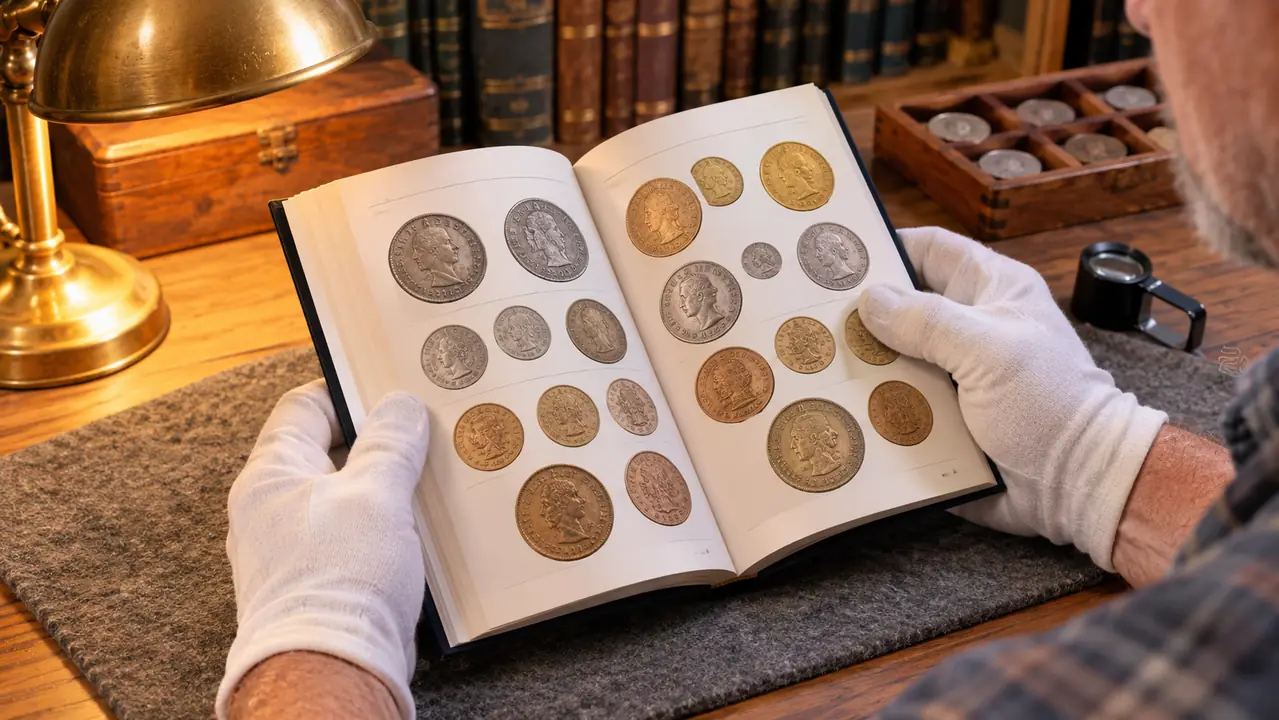
Start with grading, because that is the skill everything else rests on and it is where this book does the most teaching. Every series gets wear descriptions that walk you up from a worn piece to an uncirculated one, with photographs so you can compare what is in your hand against what the page says. When I came back to the hobby seriously nine years ago, I thought I could grade by feel. I could not. I bought a twenty power loupe and a roll of Jefferson nickels from the bank on Monroe Street, and I worked through them a few at a time after supper with the desk lamp angled low, comparing the detail on the reverse against the photographs on the page. The first pass was humbling. Three coins I had set aside as uncirculated were nothing of the kind, and one nickel I had been quietly proud of showed a rim nick I had somehow never noticed in two years of owning it. By the time that roll was finished in the spring I could at least tell honest wear from a hard life, which is more than I could say in January. No other single section of any book I own has saved me from as many bad purchases.
Then there is the part that has nothing to do with money at all: the history. Mintages, designers, weights, metal content, the dates when a design changed and why. When Tyler, my ten year old grandson, pulls a worn penny out of the change jar on a Sunday and asks me how old it can be, the Red Book is what I hand him. He reads the date off the coin, finds the year in the listing, and then wants to know who put the face on the front. That is the whole reason I keep collecting at sixty seven instead of just storing metal in a box. A price guide that also tells you the story is a different kind of object than a table of numbers, and Whitman has been getting that balance right for a very long time.
Where the Blue Book Wins
Now the honest part. If you walk into a show with coins to sell, the Red Book is the wrong book in your hand, and no amount of affection for it changes that. The Blue Book prints the other column. It tells you what dealers pay, grade by grade, which is the number you are actually being offered when somebody across the table says he will take the lot. I learned this the hard way at a regional show about six years ago, a Saturday in October out at the fairgrounds hall. I had eight Washington quarters in paper flips that I had decided to move, all of them dates I had upgraded, and I had the retail side memorized. I was quietly offended by every offer I heard. My first move, and I am not proud of it, was to quote the retail figure back at the first dealer, which is a polite way to end a conversation. The second fellow did not bother to explain anything. The third one, a man I had bought from for years, put his pen down and told me plainly that he could not pay retail and stay open. He had to leave room to resell, and a piece might sit in his case a year before the right buyer walked in. He was not cheating me. I was simply reading the wrong page of the hobby.
What the Blue Book does well is give you the shape of an offer before you hear it. You still have to think, because a dealer's number on a given Saturday depends on what he already has in stock, whether he has a customer waiting for that date, and the coin in his hand rather than the coin on your list. But walking in with a rough sense of the wholesale side means you can listen to an offer without flinching and answer it without guessing. It also keeps you from the other mistake, which is accepting the first number out of relief. For anyone who sells or trades more than once a year, that is worth the shelf space on its own.
I stopped being offended by dealer offers the day I started reading the same column the dealer was reading.
What Neither Book Will Do For You
Neither book will grade your coin for you. This is the one place where I will be blunt, because I have watched people talk themselves into a grade on the strength of a photograph in a guide. A book shows you the wear patterns at each level. It cannot see the cleaning, the rim ding, the hairlines from an old wipe, or the surface that looks fine under a desk lamp and terrible in daylight. I bought a Morgan dollar at a club meeting about four years ago that looked like a solid uncirculated piece under the hall lights. Under my own lamp at home, with the loupe, the hairlines were plain as day across the fields. Somebody had wiped it decades earlier and the surfaces had been living with that mistake ever since, and no printed guide was going to warn me from across a room. That took good light, magnification, and somebody with experience looking over my shoulder. A guide gets you close. It does not finish the job, and the collectors who get into trouble are the ones who expect it to.
Neither book predicts anything either. I do not buy coins expecting them to be worth more later, and I would gently suggest you do not either. A low mintage does not guarantee demand. A popular series can sit flat for a decade. The Red Book and the Blue Book are reference works about what coins are being sold for now, not forecasts, and I have never seen either one presented as anything else. What they will do is keep you from being surprised, and that is a modest, useful, unglamorous thing that has served me well for nine years in the coin room.
The Book That Tells You What You Would Pay, Not What You Would Get
If you buy more than you sell, and most of us do, this is the volume you will reach for every week. The 2026 edition, 79th printing, 484 pages, 4.7 stars across more than 4,500 buyers.
Amazon Check Today's Price on Amazon →
How I Use Both on a Sunday Afternoon
Sunday is sorting day in the coin room. Tyler spreads pocket change across the felt pad and I sit with the desk lamp angled low, and we go through it together. He reads the date, I check the mintage in the Red Book, and the wheat cents go into one paper flip and the modern stuff goes into a jar for the next club meeting. He has his own rules about it. Anything before 1959 goes in the flip pile no matter how worn, anything shiny gets set aside to look at twice, and anything he cannot read gets handed to me without a word. Last month he found a 1944 in a handful of change from the corner store and carried it around the house for two days. It is slow and it is not a system anybody would call efficient, but he is learning to look a coin up rather than guess, and that habit will outlast every coin in the room.
The Blue Book comes out later, when I have a pile I have decided to move. That pile is usually small, a handful of duplicates or a date I upgraded, and I check the wholesale side so I know what to expect before I walk into the hall. I write the numbers on the back of a paper flip in pencil, which sounds fussy until you have stood at a table trying to remember whether a figure was retail or wholesale. Two books, two jobs, one afternoon. If you had asked me ten years ago whether I needed both, I would have said no. Now I would say the Red Book is the one I would keep if I could only keep one, and the Blue Book is the one I would miss the first time I had coins to sell.
Who Should Buy Which
Buy the Red Book first. That is the plain answer for almost everyone reading this. If you are new, if you buy more than you sell, if you want the grading help and the mintages and the story behind the design, this is the volume that will sit open on your desk rather than shut on your shelf. Whitman prints both of these books and I have never had a reason to go looking for a third. At 484 pages and 1.65 pounds it is not a pocket book, but it is the one I would hand a brand new collector without a moment of hesitation. Everything I know about grading, I learned from that section and a roll of nickels.
Add the Blue Book when you start selling or trading with any regularity, and not before. If you only move a few duplicates once a decade, ask the dealer what he is working from and leave it at that. But if you are at the club meeting every month with flips in your case, or you go to two or three regional shows a year, the wholesale side is worth knowing cold. I own both. I would not give up either one, and I would not tell a beginner to start with two books when one of them does the job they need right now.
Open the Retail Side Before You Open Your Wallet
The Red Book is the reference I have trusted since my grandfather's coffee can days, and the 2026 edition is sitting within arm's reach right now. Start there.
Amazon Check Today's Price on Amazon →