
My grandfather's coffee can held about four hundred wheat pennies and not one scrap of order. I was twelve. I poured them onto the kitchen table, made eleven piles by decade, and then sat there with eleven piles and nowhere to put any of them. That was 1970 or close to it, and the answer to that problem has not changed. You put them in a folder. Not a box, not a bag, not a rubber band around a stack. A folder with a labeled hole for every date, so the set tells you what you are missing instead of you trying to remember.
The folder on the shelf above my desk right now is the Official Whitman Coin Folder for Lincoln Cents, Collection #3, covering 1975 through 2013. If your change habit has been quietly filling a jar since the Ford years, this is the stretch of cents you most likely already own. I have worked through two of these, one for myself and one with my grandson Tyler, and I have a fair amount to say about where the Whitman folder helps and where it stops.
The Quick Verdict
A plain folder that does the one job it claims: it takes the 1975 to 2013 pennies out of the jar and puts every open hole in front of you. Not protection, not storage for anything valuable, and it never pretends to be.
Amazon Check Today's Price →The cents in your jar are already the start of a set
Most of the 1975 to 2013 run is still moving through ordinary pocket change, which means this folder can start filling the week it arrives. Pull the jar out, sort by date, and count how many holes close on the first pass.
Amazon Check Today's Price on Amazon →How I've Used It
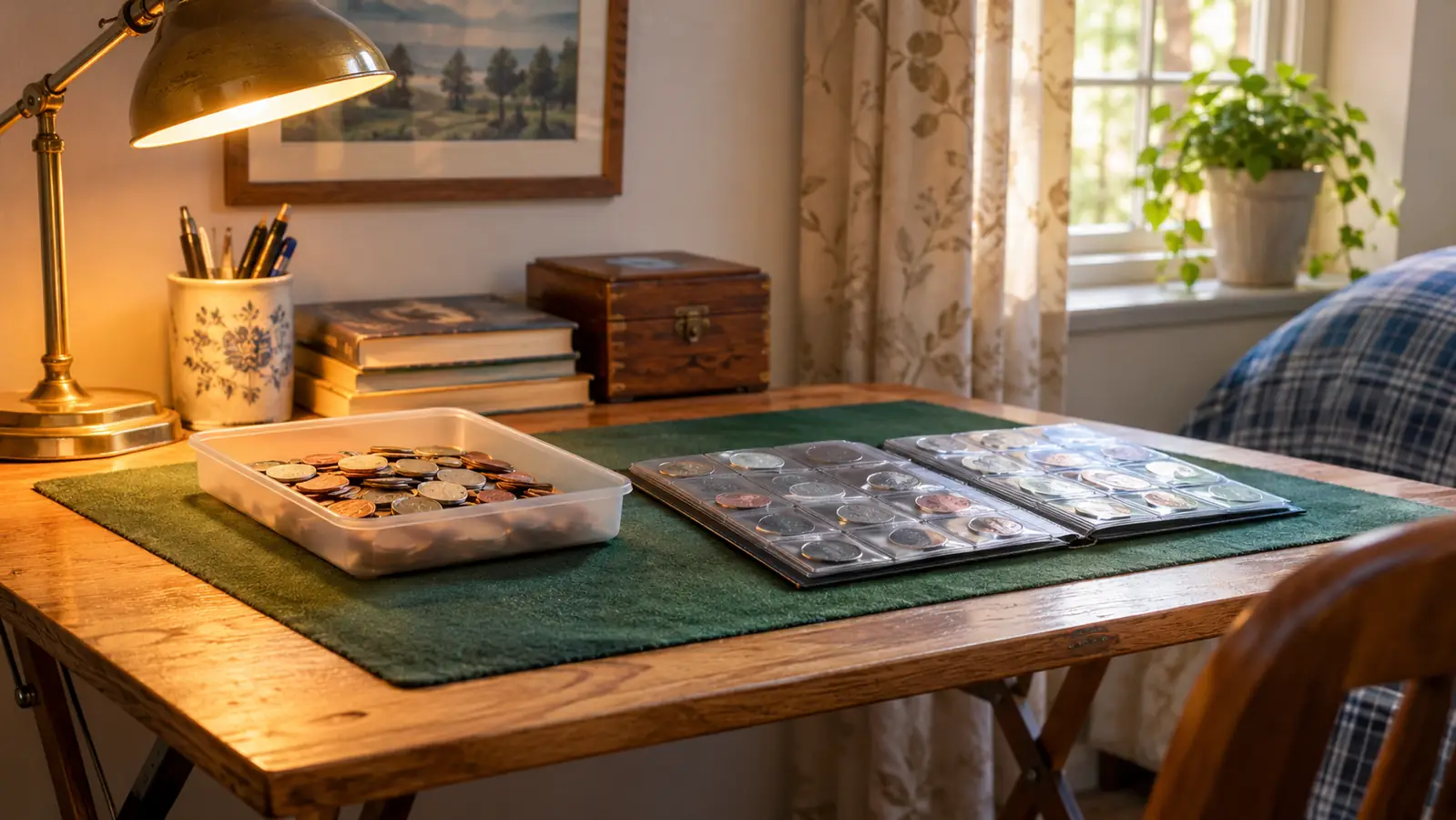
The coin room is a spare bedroom with a folding oak desk against the wall, a desk lamp, a felt pad, and a shallow plastic tray that catches what I am sorting. The Whitman folder lives on the shelf above the desk, not on it, because the desk is where a sleeve catches an edge and forty pennies end up on the carpet. I bring it down on Sunday afternoons when Tyler comes over with whatever he has talked out of his grandmother Carol's purse and the change jar by the back door. He is ten. He sorts fast and reads dates slow, which is about right for ten.
The first folder took most of a winter, because I made a rule that I would not buy a single coin to fill it. I wanted to know what pocket change alone would do across 1975 to 2013. The answer is that it does more than you would guess and less than you would hope. Most of the run showed up inside a few months of ordinary sorting. Then it stalled, and the holes that stayed open stayed open for a reason I could usually explain and occasionally could not.
The second folder is Tyler's and it is moving faster, because a ten year old will ask every adult in his life to empty their pockets and read the date out loud, and adults find that charming in a way they would not find it coming from me. He has closed holes I am still hunting. That is the folder doing its actual job. It turns a jar into a wanted list, and a wanted list is a thing you can act on.
What You Actually Get
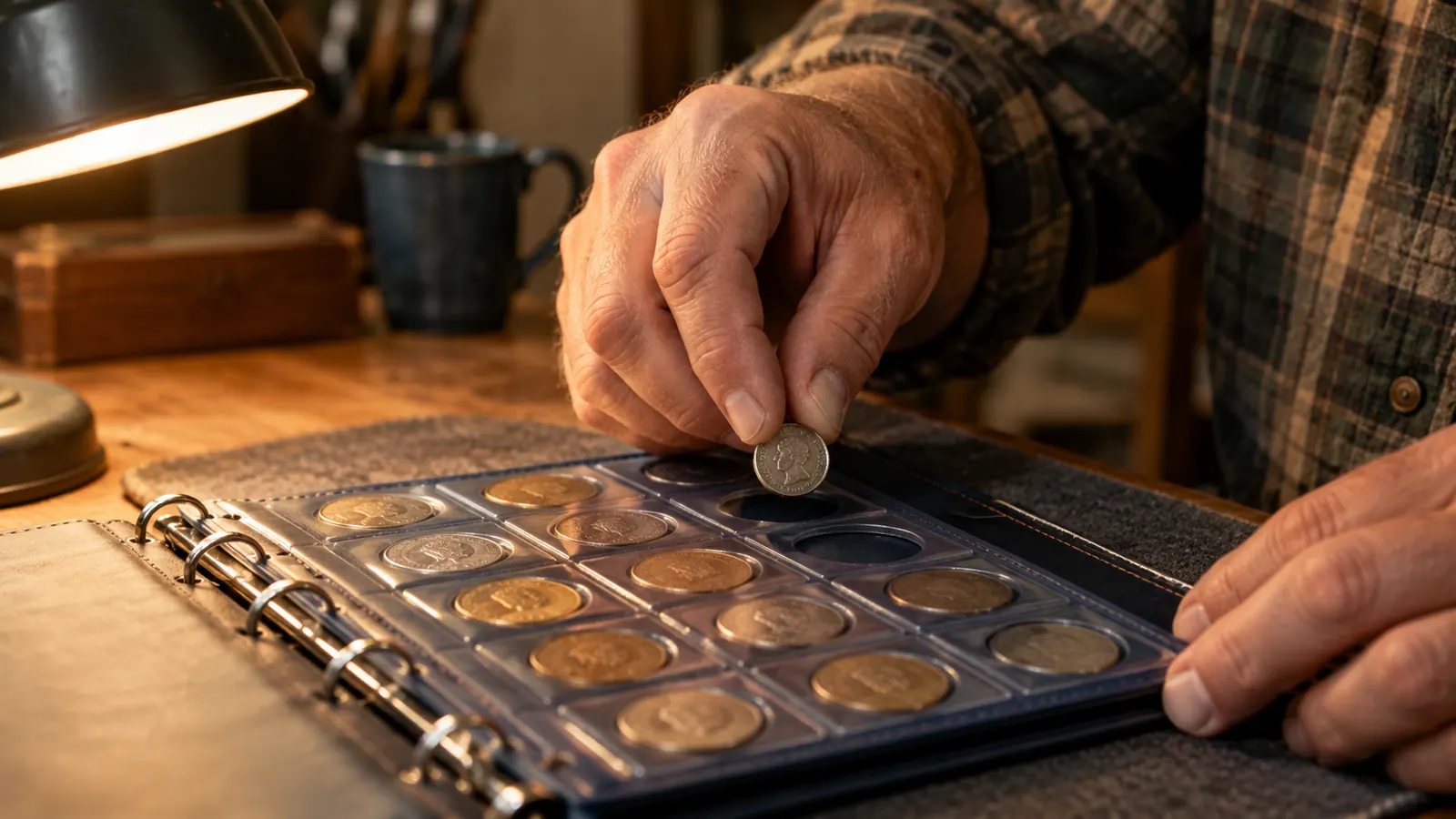
Physically it is a small object. The listed dimensions are 7.75 by 5.93 by 0.28 inches and it weighs 3.53 ounces, so it is thinner than a magazine and lighter than most of the hardbacks on my shelf. Three pages, published by Whitman-CDN Publishing, in English. It opens flat on the felt pad, which matters more than it sounds like it should, because a folder that will not lie flat means you are holding it open with one hand and pressing coins with the other, and that is how coins get dropped.
The dates printed over the holes run 1975 through 2013. One listing detail looks odd beside that: the publication date shows July 1, 1987, which cannot be the day the 2013 holes were designed. I noticed it and I expect you will too. It reads to me like a cataloging detail carried on the same ISBN for decades rather than anything about the object in your hands. The thing to check when yours arrives is the range printed on the pages, not the date in the listing.
It is a folder, not an album, and the difference matters. An album has pages in a binder, holes you can add and rearrange, and a future you keep buying. This is a fixed set of pages inside a cover, and the set is decided for you. For a dated run of Lincoln cents that is a feature rather than a limit. You cannot talk yourself into expanding it, reorganizing it, or ordering another pack of pages, because there are no more pages to order.
Getting a Cent Into the Hole Without Damaging It
Two rules, and I will state them plainly because I have watched people hurt coins at club meetings. Hold the coin by the rim, not the face. And do not force it. If a cent does not seat with light pressure from a thumb, then the hole is not the one it belongs in, or there is a burr at the edge, or the coin is bent. Forcing it is how you put a scratch across the cheek of Lincoln that was not there before you started.
I wear nitrile gloves for anything uncirculated and bare hands for circulated cents, and that is the habit I would pass on. Uncirculated copper picks up skin oil and holds it, and a fingerprint that sits on a red cent for a decade is not something you can undo later. Circulated cents have already been through every pocket in Ohio. I am not going to pretend a glove changes anything for those.
Here is the part I want to be straight about, because it is the part people get wrong. A folder is storage. It is not protection. The coins sit in open holes with the reverse hidden and the air reaching them, and a cent that went in with a spot of active corrosion will still have that spot in five years, possibly more of it. If a coin is genuinely valuable, it does not go in here. It goes in an airtight holder and then somewhere dry, and this folder is for the run you are building out of pocket change.
Running the Years in Order
The folder forces sequence on you, and sequence is where the learning happens. You start at 1975 and work forward, and by the third or fourth session you are recognizing the shape of a decade without reading anything. You notice that a 1975 penny and a 1979 penny feel identical in the hand and only the date separates them. You notice that 1982 pennies come in two different metals and that you can see the difference at the rim if you tilt one under the lamp. I had been handling cents for fifty years and had never once looked at the rim of a 1982 penny.
None of that was on my list when I started. I wanted a filled set. What I got was a working knowledge of a forty year run that I did not have before, and it came from handling the coins one hole at a time rather than from reading about them. Tyler is getting the same thing faster than I did, because he has no opinions yet about which years matter and so he reads all of them.
The other thing sequence does is make gaps visible. In a jar, a missing year is invisible, because you do not know what you have and you are not about to spread four hundred cents across a table to find out. In a folder, an empty hole becomes a specific errand. I keep a short list on the felt pad of what is still open, and I take that list to the monthly club meeting, and I have filled more holes from a five minute conversation at a folding table than from a year of casual sorting. That is not the folder's doing exactly. But the folder is what makes the list possible.

Where It Falls Short
The obvious limitation is that you only see one side. Every coin goes in face up or the run looks wrong, and the reverse of a Lincoln cent is where a good deal of the interesting die work lives. If you want to study both sides of a coin, this is the wrong object and what you want is a cardboard holder and a binder page that lets you flip it.
The second is wear on the folder itself. These are paper products and they behave like paper products. Corners soften. The spine of mine has a crease in it from being opened flat across a felt pad a few hundred times. After a decade of Sundays it will look handled, because it has been handled. That does not affect the coins in the slightest. It does mean that if you want one that stays crisp, you buy two, one to work in and one to keep, which sounds excessive until you watch a favorite folder come apart at the fold.
The third is the one that actually costs people coins, so I will say it twice in different words. There is no protection here from humidity, from air, or from a coin that is already reacting to something. Toledo summers are humid and my coin room runs a dehumidifier from June through September for reasons that have nothing to do with cents. A folder left in a damp basement will produce the same result as anything else left in a damp basement.
The fourth is small and it is mine rather than the folder's: the printing over the holes is not large. I am sixty seven and I keep a pair of reading glasses on the desk for exactly this. If your eyes are better than mine you will not notice. If they are not, plan for the glasses and do not blame the printing.
What I Liked
- One labeled hole for every date and mint mark from 1975 through 2013, so gaps are visible at a glance
- Opens flat and stays flat on a felt pad, which makes seating a coin closer to a two hand job than a three hand job
- Fixed set. You cannot keep buying pages, so the run has a defined end and a finish line you can see
- Small and light enough to carry to a club meeting, at 7.75 by 5.93 by 0.28 inches and 3.53 ounces
- The Whitman layout is the one you have seen at every club meeting, so nobody has to explain it to you
- A second copy for a grandchild is an easy thing to add to an order
Where It Falls Short
- Open holes, so air reaches the coins and the reverse stays hidden
- The paper cover softens and creases across years of use
- No help at all with a coin that is already corroding or toning
- No room for varieties, errors, or anything outside the plain dated run
- Not protection. Anything of real value belongs in an airtight holder instead
In a jar, a missing year is invisible. In a folder, an empty hole becomes a specific errand.
Who This Is For
If you have a jar, a coffee can, or a shoebox of cents from the last four decades, this is the right first object. Not the right last object. The first. It takes up a shelf slot and an afternoon, and it converts a pile into a project with a visible finish line. I would hand it to anyone who has told me at a club meeting that they have a pile of old cents and do not know where to start. I have said it to several people and I will say it here.
It is also the right thing for someone learning to handle coins, because the run is common, the mistakes are inexpensive, and there is no temptation to treat any of it as an investment. Tyler put a thumbprint on a circulated 1987 penny in his first week and the world did not end. That is the correct place to learn the habit, on coins that do not care.
Who Should Skip It
Skip it if what you actually want is storage. This is not storage. If the cents in question are uncirculated, or if you have already set them aside because of condition, they belong in an airtight holder and a folder will undo a decade of care one humid August at a time. I keep saying this because I have watched it happen to people who knew better.
Skip it if you collect varieties, errors, or anything outside the plain dated run. The holes are for dates and mint marks and nothing else, and a doubled die is not going to get its own labeled opening. And skip it if you want a set that grows. This one will not. It runs 1975 to 2013 and then it is finished, which is either the best thing about it or the reason it is wrong for you, depending on what you were hoping to get when you started.
A jar of cents is a set with holes in it. Start closing them.
The folder covers every date and mint mark from 1975 through 2013, opens flat on the desk, and holds the whole run in less space than a shoebox. Pull the change jar out this weekend and see how many holes close on the first pass.
Amazon Check Today's Price on Amazon →