

The first thing I tell anybody who asks me about the Red Book is that it is a catalog, not an oracle. I bought my copy in April, carried it back to the coin room, set it on the folding oak desk beside the felt pad, and started looking up dates the way you look up a word in a dictionary. Two hours later I knew a great deal about how many nickels came out of Philadelphia in 1950 and nothing at all about whether the nickels in my tray deserved a holder. That is not a complaint. It is an honest description of what this book does, and most of the five-star reviews do not bother to say it.
This is the 79th edition of the guide Whitman has published every spring for longer than I have been collecting, and it runs 484 pages at 9 by 6 inches and a little over a pound and a half. My grandson Tyler, who is ten and sorts pocket change with me on Sunday afternoons, calls it the fat book. He is not wrong. I have owned earlier editions and handed two of them to new members at the club, and each time I open a fresh one I find the same thing: a reference that answers a narrow set of questions very well and politely declines the rest.
The Quick Verdict
The best single place to find dates, mint marks and mintage figures for United States coins, and the wrong tool for deciding whether the coin in your hand is worth submitting. Buy it for the first job, not the second.
Amazon Check Today's Price →One book on the desk instead of six browser tabs
484 pages, 79th edition, published April 2025. If you want the mintage figures and the listed values in one place, this is the copy to own.
Amazon Check Today's Price on Amazon →What This Book Is, and What It Is Not
The book is organized by series. You find the section for the coin in your hand, you find the date and the mint mark, and you read across the columns to the grade. That is the whole interaction, and once you know your way around it takes about a minute. I use it faster than the free lookup sites, mostly because a book does not interrupt me with an advertisement for a coin I did not ask about.
The layout takes some learning, and I want to be fair about why. The pages are set in narrow columns of small type, one row per date, and the grades run across the top. On my first pass with a roll of nickels I kept reading across the wrong line and coming up with a figure that belonged to the date below the one I actually cared about. Nothing in the book warns you about that. You find out because the number looks wrong, you back up, and you learn to hold your place with a finger the way you did with a phone book. By the third Sunday I had stopped making the mistake. A thinner guide with bigger print would be easier for a week and useless for a year, so I am not complaining. A beginner should just expect an hour of fumbling before the pages start to behave.
What it is not is a grading course. This is the part that matters most, and it is the part I would print on the cover if Whitman asked me. The guide lists a value next to a grade, but it does not teach you to see the difference between a coin that has been cleaned and one that has not, or between a weak strike and honest wear. I have been at this seriously for nine years, since I retired from teaching shop, and I still hand anything uncirculated to a friend at the club before I decide anything. No book does that part for you.
The other thing it is not is a set of offers. A value printed in a reference book is a starting point for a conversation, not a promise that somebody will hand you that amount at a show on a Saturday afternoon. Dealers buy below what they sell at. Everyone in the hobby knows this. Almost nobody writes it down where a beginner will find it, so I say it out loud at the club meeting every month, and every month somebody looks surprised.
How I've Used It Since April
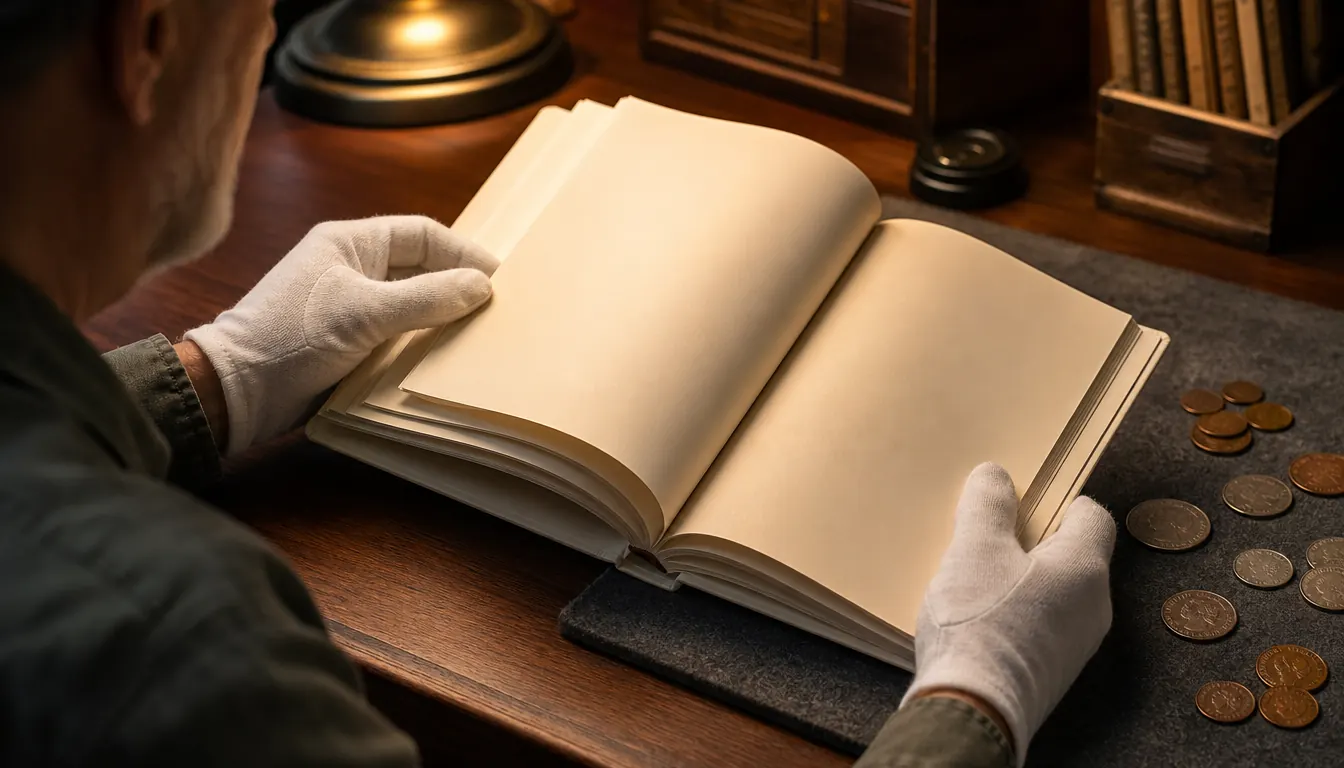
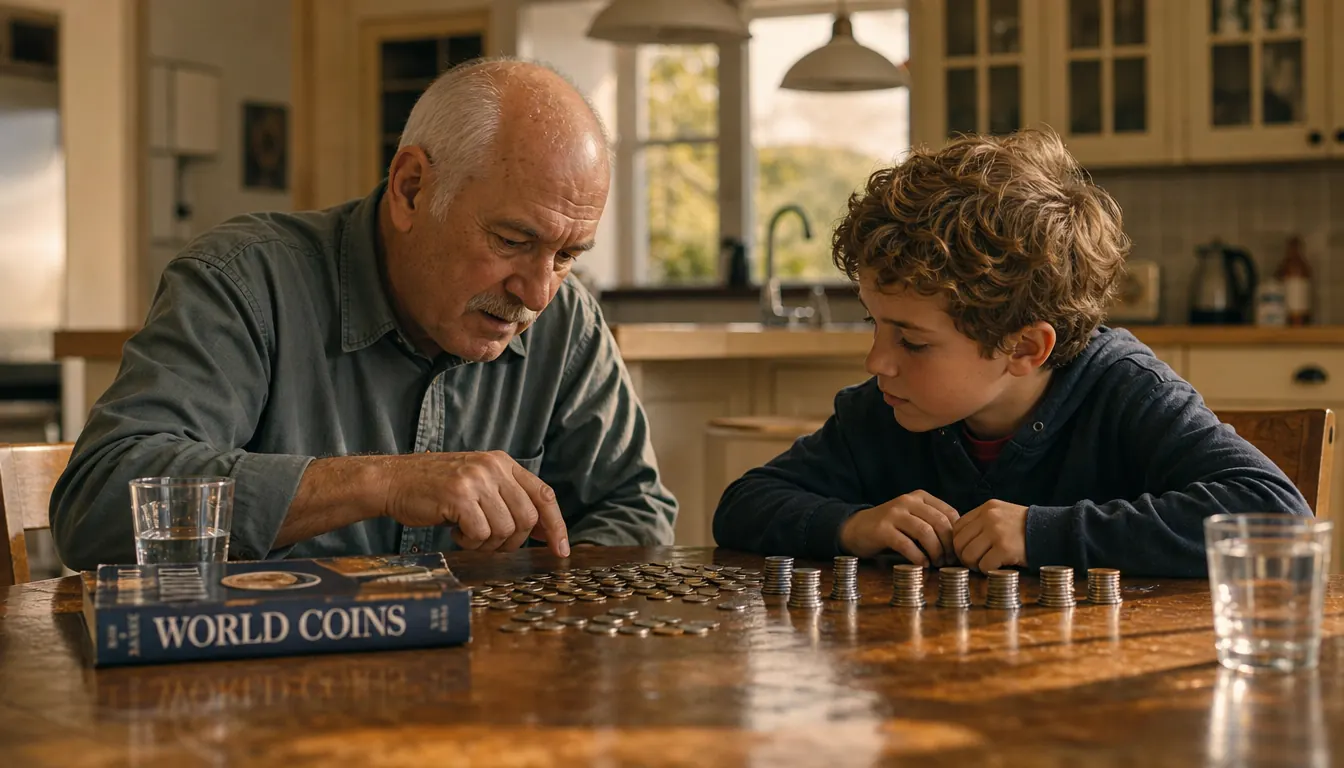
Tyler and I have a Sunday routine. Carol makes lunch, Tyler dumps his pocket change onto the felt pad, and we sort into little piles by denomination. Since April the guide has been open at the end of the desk for that hour. Mostly we use it for mintage figures. Tyler is ten, so bigger numbers are funnier to him, and he has decided that a 1965 quarter with hundreds of millions of siblings is a better joke than a scarce date. I am not correcting him yet.
One Sunday in May it did real work. Tyler had a pile of Jefferson nickels going back to the war years, and he wanted to know why some of them had a letter above the building on the back and some did not. I did not know the answer well enough to explain it, so we looked it up together. The guide showed us where the mint mark sits on each series and which years used which location, and twenty minutes later he was sorting them on his own and telling me which ones came from Denver. That is the entire value of a reference like this in one small story. It did not tell him a nickel was worth anything. It taught him to look at a nickel properly, and that is the thing that lasts.
Where the book earned its keep for me was in a roll of Jefferson nickels I bought at the club auction. Two dates would not settle down in my head, and it turned out I had been reading a mint mark wrong for years without knowing it. Ten minutes with the guide and the whole thing straightened out. That is the kind of correction this reference is good at. Nothing dramatic. It just stops you from being wrong.
It lives at the desk and not on the shelf. At 1.3 inches thick and about a pound and a half, it is not something I balance on a knee while sorting a tray of cents. Nine by six inches open leaves room for the felt pad and the plastic tray, which is exactly how the coin room is set up. If you sort at a kitchen table, the same arithmetic applies, and you will want the lamp close.
I took it to a regional show in the fall, which I do not usually do, because I wanted to check some values away from home. It was useful in a way I did not expect, and not because of the numbers. Having it open on the table let me ask a dealer a better question. I pointed at a date and said I could not tell the difference between two grades, and he showed me, with a loupe, on a coin already in his case. The book was the excuse for the conversation, and the conversation was worth more than the book.
Ten minutes with the guide and I understood that I had been reading a mint mark wrong for years.
The Parts Nobody Mentions in the Five-Star Reviews
The edition is dated 2026 but the publication date is April 8, 2025, which means a good deal of what you are reading was assembled before that. Every value in a guide book is a snapshot of a moment. On common material that hardly matters. On the dates that actually move, it matters a lot, and the book has no way to tell you which is which.
Buying rhythm matters too, and nobody explains it to a first-time buyer. The book comes out in the spring, and by summer the previous edition is being sold off cheap. I have bought in April twice now and I will keep doing it, because those twelve months between editions are exactly the window when your copy still matches the trays you are looking at. If your budget is tight, buy the current edition and skip something else that month. A worn copy of the right edition beats a fresh copy of the wrong one, and I did not invent that line. I learned it by wasting money on the wrong one.
The reading age is listed as 8 years and up, and I want to be careful about what that means. Tyler is ten, reads at the top of his class, and can read this book without help. He cannot use it. Reading level and usefulness are two separate things, and a parent who sees 8 and up and buys this for a second grader is going to be disappointed on Christmas morning.
There is a lot of book here. Four hundred eighty-four pages of it. The answers are all in there, but you will spend your first week learning where they live, and the printing is dense enough that my reading glasses are not optional. That is not a flaw in a reference book. It is a description of one, and it is worth knowing before you buy rather than after.
A used older edition is not the same product, and this trips up more people than anything else. If all you want is mintage figures, an older copy will do fine, because how many cents came out of Philadelphia in 1881 does not change. If you want values, buy the current one. I watch people at shows save a little by buying three editions back and then ask me why the numbers look strange next to a dealer's tray.
What It Will Not Do for You
It will not tell you whether a coin has been cleaned, dipped or otherwise fooled with, and it will not tell you whether it is counterfeit. Those two questions decide most of the money in this hobby, and both of them need a person with experience, a loupe and decent light. The guide gives you the context to have that conversation. It does not have the conversation for you.
It will not tell you what to buy. I do not give investment advice and neither does any collector I respect. A book full of numbers can start to look like advice if you squint at it, so let me be plain. Those numbers describe the past. They are not a forecast, and nobody at Whitman is telling you otherwise.
It will not keep you from overpaying either, and that catches people who have just bought their first copy. Seeing a number printed beside a date feels like a floor under the coin. It is not. It is a description of a market that the dealer across the table is also reading, except he has the coin in his hand and you are reading about a coin in general. The number is a way to start talking. It is not a way to win an argument, and if you treat it as one you will lose a little money and learn the lesson the hard way, which is how most of us learned it.
And it will not replace the club. That sounds like an old man talking, and it is, but the monthly meeting is where I learned to grade. Dues and a couple of hours a month is the whole cost. The guide is what you bring to the meeting, not what you bring instead of it. If you are the only person in your house who cares about coins, that meeting is worth more than any book on the shelf.
What I Liked
- One place for dates, mint marks and mintage figures across the United States series
- Values are listed by grade, so you see the spread instead of a single flat number
- Large enough to read comfortably at a desk, compact enough to sit beside a sorting tray
- Reissued every spring, so a current copy stays tied to the present
- Easy to hand to a new collector at the club and let them keep it
Where It Falls Short
- Printed values are reference points, not offers from a dealer
- Teaches no grading, cleaning detection or authentication
- Every value carries the age of the edition it was printed in
- Dense enough that a first-time reader spends a week learning the layout
- The 8 and up reading age describes reading level, not whether a child can use it
Who This Is For
If you inherited a coffee can of wheat pennies and old nickels the way I inherited one from my grandfather at twelve, this is the book to buy first. You will not know what you have, and the guide will not tell you either, but it will tell you which dates exist, which mint marks to look for and how many were made, and that is the groundwork. From there you can walk into a club meeting and ask a question worth asking.
It is also for the collector who has been at it a while and is tired of six browser tabs. I am in that group, and the guide has earned its place on my desk for exactly that reason. It makes a decent gift for a young person who is already curious about coins, provided the adult in the room understands that the child will need help finding their way around the layout for the first month.
There is one more group I would add, and it is the person who has been handed a whole collection and does not know what to do with it. That happens more than people think. A parent dies, a box comes home, and it sits in a closet for a year because nobody wants to be the one who gave away something valuable. Buy the guide before you open the box. It will not appraise anything and it will not make the decisions for you, but it will let you sort by series and by date so that when you finally do walk into a shop or a club, you walk in with a list instead of a box. That hour of sorting is the difference between a conversation and a donation.
Who Should Skip It
Skip it if the only question you have is what one specific coin is worth and you want an answer today with no interest in the rest of the hobby. Ask a dealer instead, or bring the coin to the club. Skip it if you are hoping for something that predicts which dates will rise, because that book does not exist at any length and this one is honest enough not to pretend. Skip it too if you want to learn grading in a hurry. Grading is learned at a table with a loupe and a patient teacher, not from 484 pages of columns.
And skip the used copy three editions back if values are what you are after. Buy the current one, or wait until next spring when Whitman puts out the next edition and the older ones get cheaper for the collectors who only need mintage figures. That is a real use for an old copy. It is just not the use most people have in mind when they buy one.
If you keep coins in a spare room, keep the current edition on the desk
The 79th edition is the one I reach for on Sunday afternoons and the one I hand to new members at the club. Get it once and stop guessing at mint marks.
Amazon Check Today's Price on Amazon →