
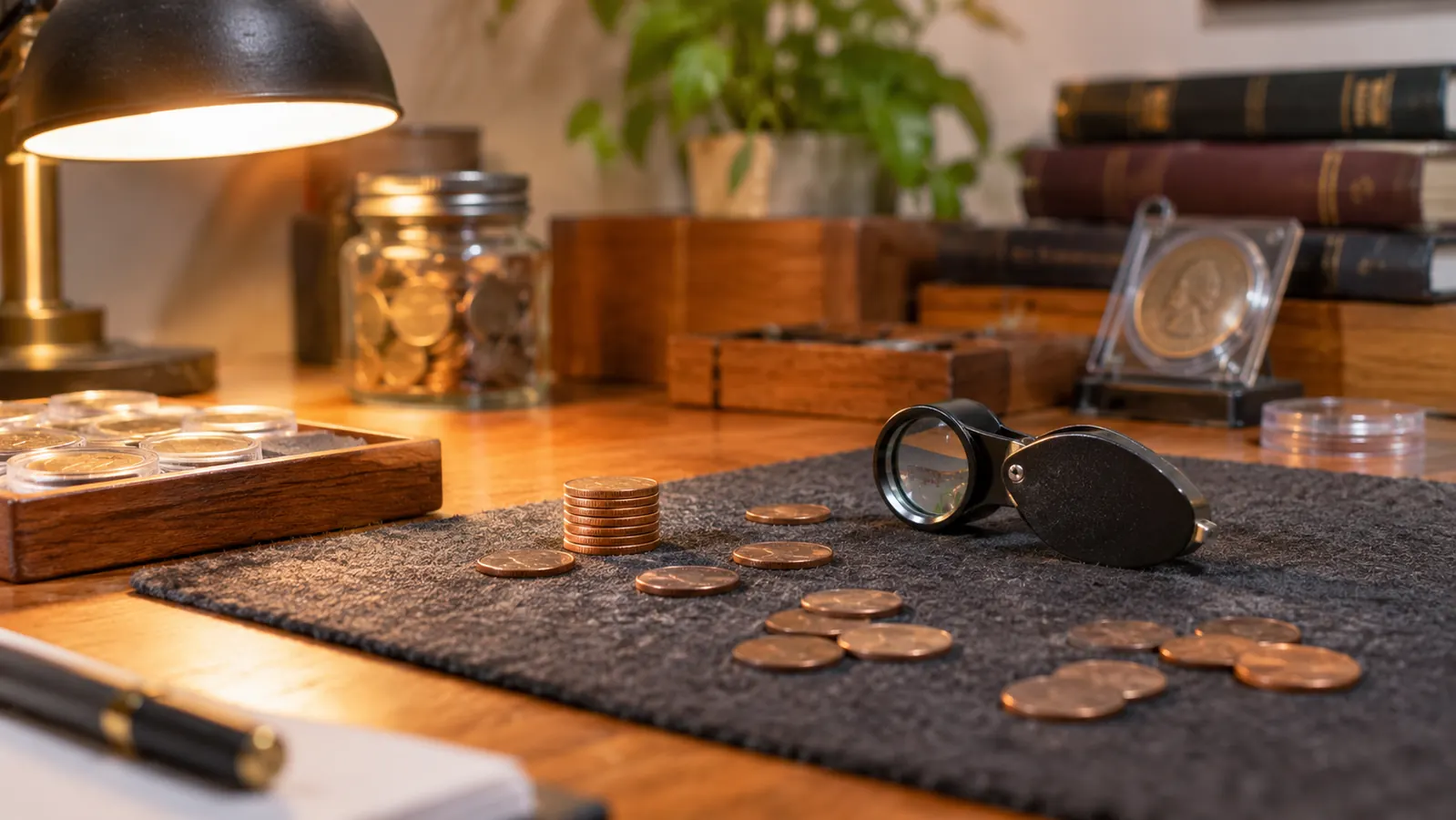
I bought the JARLINK 30X 60X illuminated loupe expecting to be disappointed. That is not modesty. I have owned four loupes in the last nine years, and three of them were the kind of plastic thing that turns up in a drawer six months later with a dead battery and a scratched lens. What I wanted was a cheap second magnifier I could keep in the coin room drawer and not worry about, so the good one stayed in the safe case.
What I got was better than I expected and worse than the reviews suggest. Both things are true at once, and an honest review has to hold them together. The JARLINK is a real tool. It is also a tool with a resin lens, a battery door held by a screw, and a 60X setting I would not trust for a single attribution decision. If you want the short version: buy it as your travel loupe and your beater, not as the glass you use to decide whether a 1909 penny is worth sending in. I made the opposite call once with a cheap magnifier and talked myself into a variety that a club member politely corrected.
The Quick Verdict
A genuinely useful cheap loupe with honest limits: great light, decent 30X view, and a 60X setting that is more curiosity than instrument.
Amazon Check Today's Price →If a drawer loupe is all you need, this is the one I'd grab
The JARLINK 30X 60X is the magnifier I keep in the desk drawer instead of the safe. Illuminated, battery powered, and small enough to forget about until you need it.
Amazon Check Today's Price on Amazon →What Nobody Tells You Before You Open the Box
The first thing I noticed was the weight, or the lack of it. Twenty-seven grams. My wedding ring weighs more. That sounds like a compliment and it partly is, because a loupe you forget in your shirt pocket is a loupe you actually carry to a club meeting. But light weight in a magnifier usually means plastic, and plastic means the lens is held in a molded frame rather than in machined metal.
The second thing is the lens material, which the listing states plainly: resin. Not glass. Every review that calls this an optical instrument and then never mentions resin is leaving out the single most important specification on the page. Resin lenses are fine. They are also softer than glass, they scratch if you look at them wrong, and they pick up a static charge that pulls dust onto the surface like a magnet pulls a paperclip.
The third thing, and the one I wish I had known, is that 30X and 60X are not a zoom. There are two lenses. The primary lens is 30X and 22mm across, and the supplementary lens is 60X and 12mm across. You use one or the other. There is no dial, no slider, no adjustment between them. That matters because 12mm of viewing area is smaller than the date on a Lincoln cent, and holding a coin steady under a 12mm window at 60X is a two-handed job that my hands are not reliably good at anymore.
How I've Actually Used It
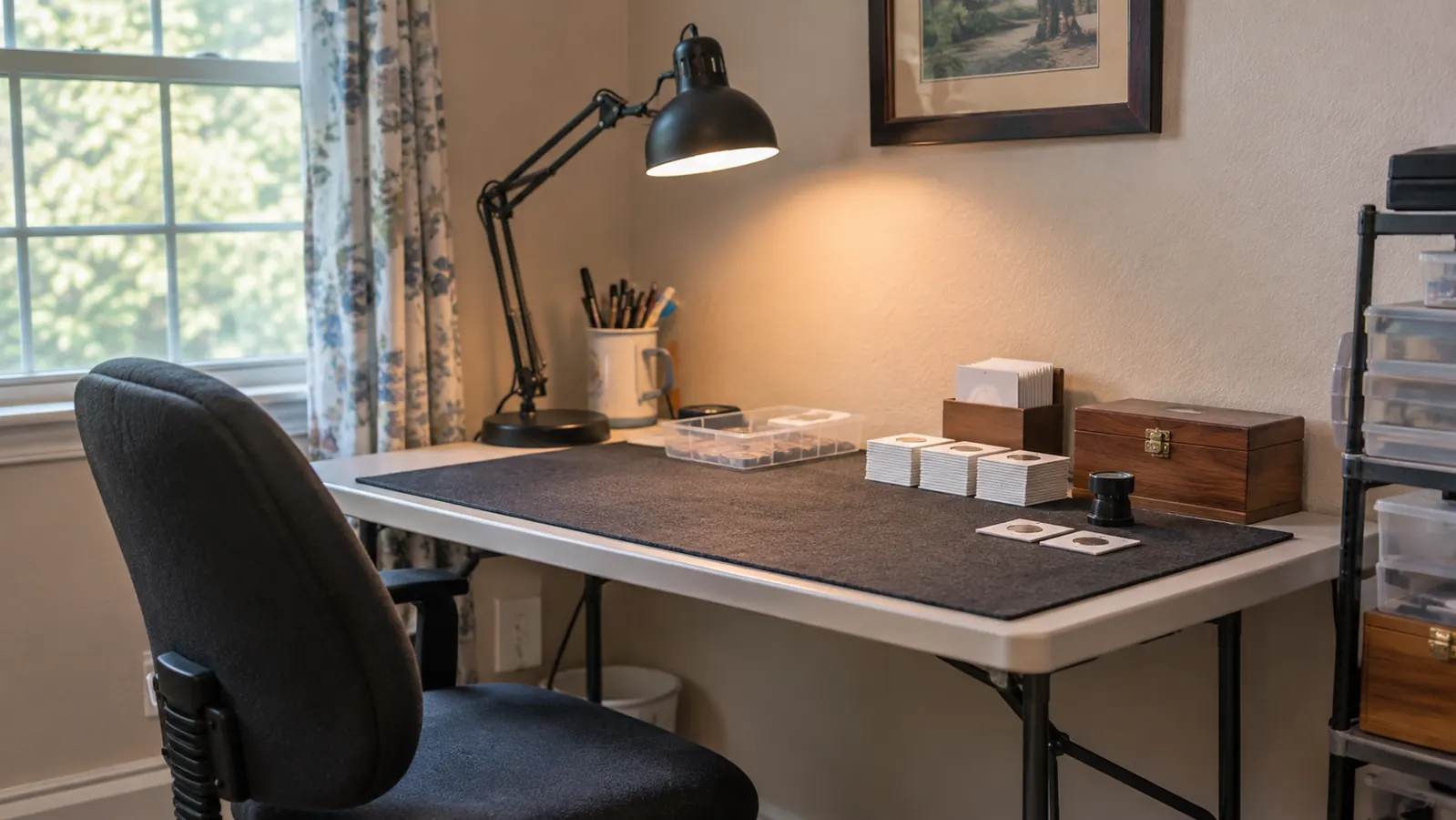
My coin room is a spare bedroom with a folding oak desk, a desk lamp, a felt pad and a small plastic tray. That is the whole setup. I keep my Lincoln cents in cardboard holders, my nickels in a Whitman folder, and the silver dollars wrapped separately because I do not want them sliding around. When I sort, I hold coins by the edges and I put on nitrile gloves for anything uncirculated.
I used the JARLINK for six weeks, from the middle of January into the last week of February, in three situations. First, Sunday afternoons with my grandson Tyler, who is ten and sorts pocket change with me. Second, a monthly club meeting where I wanted something small in my pocket. Third, my own close work on a run of circulated Washington quarters I was trying to fill holes in.
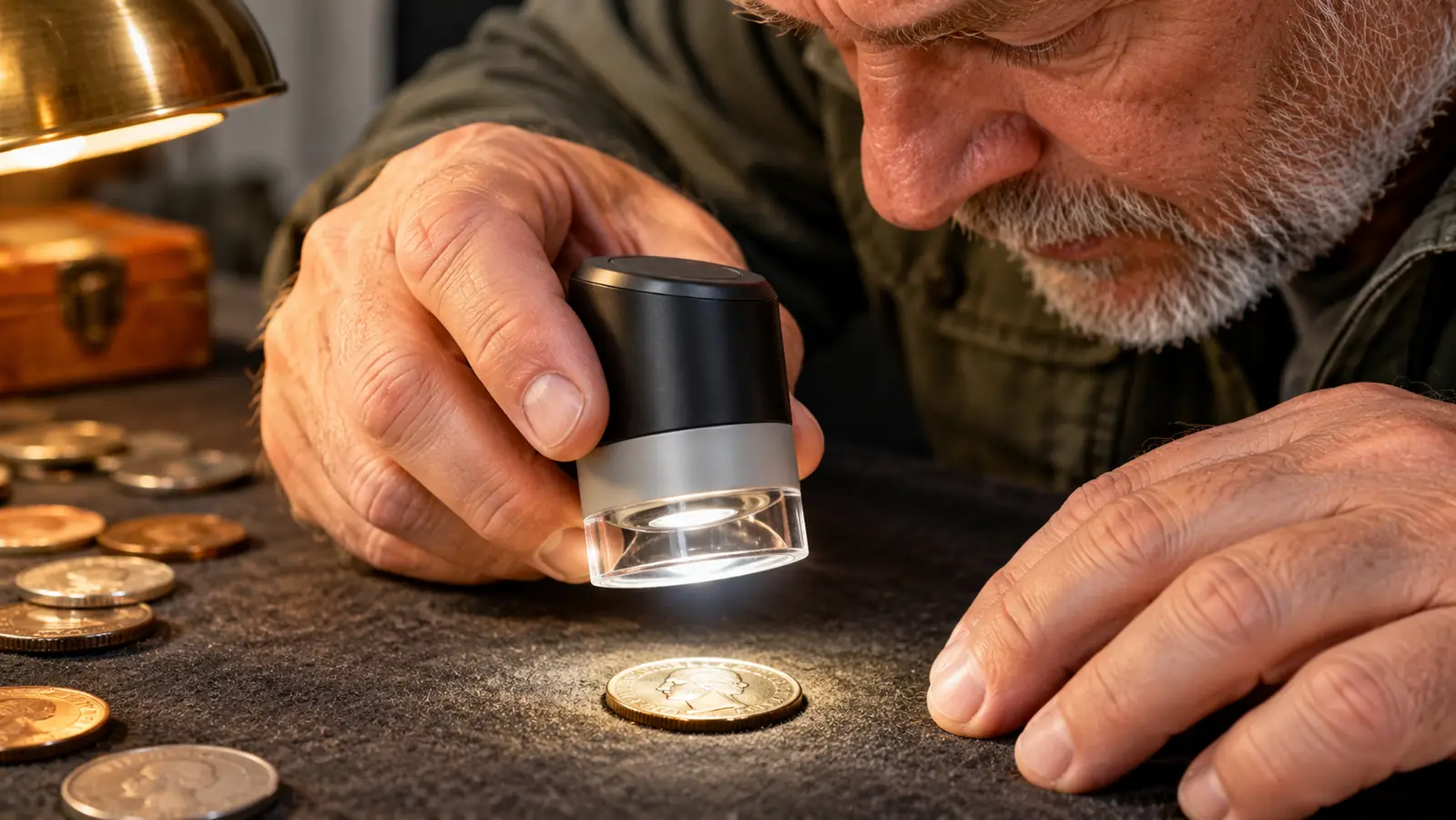
Sunday sorting is where it shines. Tyler pulls a coin, I switch on the light, and we both look. The LED does what the listing claims: it puts light on the subject at a workable angle, and on a dark felt pad the difference is not subtle. Copper dates that were a smudge under my desk lamp read clearly under the loupe light. I do not have to tilt the coin toward a lamp and hold it there. That alone justified keeping it in the drawer.
The club meeting is where the small size earned its place. I did not have to carry a case. I dropped it in my jacket, forgot about it, and used it twice to look at another member's nickel. Nobody commented on it being cheap. Nobody asked what it was. It did the job, and it came home in the same pocket.
The quarters are where it started to frustrate me. Not because the optics are bad, but because 30X through a 22mm lens is a fixed distance problem. You have to hold the loupe at the right height above the coin, and the right height is roughly where the plastic body nearly touches the felt. My hand drifts. The image goes soft at the edges when the loupe tilts a couple of degrees off perpendicular. I found myself resting my wrist on the desk and bracing with my other hand, which is fine for one coin and tedious for forty.
I tried two other approaches before I settled. The first was holding the loupe in my left hand and the coin in my right, which lasted about three coins before I gave up; the coin never sat flat and the light kept catching the rim. The second was propping the loupe on a stack of two empty cardboard holders to fix the height. That one actually worked for reading dates, but the stack slid every time I bumped the desk, and I spent more time resetting it than looking. What finally worked was a folded washcloth under the felt pad, which raised the coin surface about a quarter inch and let my wrist rest at a natural angle. It is not elegant. It is what I do now.
The light is the best thing about this loupe. The resin lens is what keeps it in the drawer.
The 60X Setting, Honestly
I want to be fair here, because the backlash against high magnification claims has gone too far in the other direction. The 60X lens works. It magnifies. If you put a mint mark under it in good light, you will see the mint mark larger than you have ever seen it.
What you will not see is a clean image across the whole field. The usable area is a small circle in the middle, and the edges fall off into color fringing and blur. The working distance is short enough that the lens body shadows the coin unless the LED is on, and the LED sits on the fixed ring, so it lights the center and leaves the rim dim. For identifying a mint mark, that is acceptable. For judging whether a coin has been cleaned, or whether a scratch is a planchet flaw or post-mint damage, it is not. That kind of call needs a triplet loupe with coated glass and a wide flat field, and no amount of magnification on a resin lens substitutes for it.
The case that taught me the difference was a 1939-D Jefferson nickel I pulled out of a roll in February. Under the JARLINK at 60X I found the D without any trouble at all, sitting there to the right of Monticello, clear as day. But when I turned the coin to check the steps and the field for hairlines, the whole right side of the view went soft and I could not tell a light scratch from a reflection. I put it under the glass triplet I keep in the case, and the same field showed two faint parallel lines I would have missed entirely. The nickel is not valuable either way. The point is that the cheap loupe found what I was looking for and then told me nothing about what I was not looking for.
So the practical rule is this: I use the 30X for almost everything, and I use the 60X to confirm a mint mark and nothing else. That is a real use. It is just narrower than the marketing implies.
Batteries, the Door, and the Long Haul
The loupe runs on button cells. The package includes three LR1130 batteries, which is thoughtful, and a small screw, which tells you what the battery door situation is. The door is held by that screw. It is secure, and it is also the reason I stopped changing batteries in a hurry. If you have tried to seat a tiny screw into a plastic thread on a dark felt pad at nine at night, you know how that goes.
Battery life has been fine in my use, because I only switch the light on when I am actually looking. If you leave it on, you will be changing cells more often than you would like. There is no auto shutoff that I have found, and no indicator. The light dims before it dies, which is a warning of sorts. The package also includes a fabric bag, and I use it, mostly to keep dust off the resin.
The first battery change cost me twenty minutes. I had the loupe open on the desk, the old cells out, and the screw rolled off the felt and onto the carpet. I found it with a flashlight on my knees, which is not how I wanted to spend a Wednesday evening. Since then I change batteries over the plastic tray, and I keep the spare screw in a small envelope in the drawer. That is the kind of small annoyance that never shows up in a star rating and does show up in how often you reach for the thing.
One more thing nobody mentions: the resin lens and dust. Because the lens is resin, it holds static. I keep a clean microfiber cloth in the drawer and I wipe the lens before every session. If you wipe it with your shirt, you will eventually put a fine scratch in it, and a scratch on a 22mm resin lens is visible in the view. It is not a dealbreaker. It is maintenance you should expect.
What Holds Up After Six Weeks
What I Liked
- The LED does real work. Dates on worn copper read clearly against a dark felt pad.
- Twenty-seven grams and small enough for a jacket pocket, so it actually travels to club meetings.
- Two lenses in one cheap tool: 30X at 22mm and 60X at 12mm.
- Ships with three LR1130 batteries, a fabric bag and a spare screw.
- The 30X view is good enough for sorting, reading dates and spotting mint marks.
Where It Falls Short
- Resin lens, not glass. It holds static, attracts dust and scratches easily.
- The battery door is held by a screw, so changing cells is a desk job with good light.
- The 60X image is sharp only in a small center circle, with fringing toward the edges.
- Fixed working distance with no adjustment, which is unforgiving if your hands drift.
- No auto shutoff and no battery indicator, so the light just fades out on you.
Who This Is For
This loupe is for the collector who wants a second magnifier that lives in the desk drawer and gets used without ceremony. It is for the person sorting a coffee can of wheat pennies who wants to read dates quickly and does not need a flat field. It is for the club-goer who wants something in a pocket. It is for a grandparent sorting change with a kid, where the light and the low cost matter more than optical purity.
It is also a reasonable first loupe. If you have never owned one and you are not sure what magnification you actually want, this is a cheap way to find out. Spend a few weeks with 30X and 12mm of 60X, and you will know exactly what to look for when you buy the good one.
Who Should Skip It
Skip it if you are making attribution calls. Cleaning, artificial toning, hairlines, die variety diagnostics at the margins, anything where you intend to write a note on a holder or send a coin to a grading service. For that work you want a triplet loupe with glass optics and a wide field, and you want to pay for it. The JARLINK will show you a mint mark. It will not show you the truth about a surface.
Skip it if your hands are unsteady and you work standing, or without a surface to brace on. The fixed working distance is unforgiving, and the small 60X window punishes any drift. Skip it also if you want one tool for the next fifteen years. A resin lens under regular use will not last like glass, and the plastic battery door is the kind of part that fails before the optics do.
And skip it if you already own a decent illuminated loupe. There is no reason to own two of these. The honest case for the JARLINK is that it is the cheap one you do not mind losing. If you already have the good one, you have already solved the problem this addresses.
What I'd Tell You in the Coin Room
The mistake people make with magnifiers is buying magnification instead of buying optics. 60X sounds like more than 10X, so it must be better. It is not. A 10X triplet with coated glass and a flat field will show you more about a coin than 60X through a resin lens, because what you need is a clean image across the surface, not a bigger blurry one.
So my advice is unglamorous. Buy this one for the drawer and the pocket. Buy a good triplet for the decisions. Keep a microfiber cloth with it. Change the batteries at the start of a sorting session rather than in the middle of one. And do not let a cheap loupe talk you into a confident opinion about a coin, because the tool will not warn you when it is out of its depth.
I still use mine most Sundays. Tyler has learned to hold the coin flat and let me handle the loupe, and we get through a roll of cents in about twenty minutes. That is worth what I paid. What it is not worth is the assumption that a 4.3-star average and thirty thousand reviews means the optics are better than they are.
The drawer loupe I keep coming back to, limits and all
If you want a small illuminated magnifier for sorting and reading dates, the JARLINK 30X 60X does that job without fuss. Just buy it knowing what the 60X is and is not.
Amazon Check Today's Price on Amazon →