
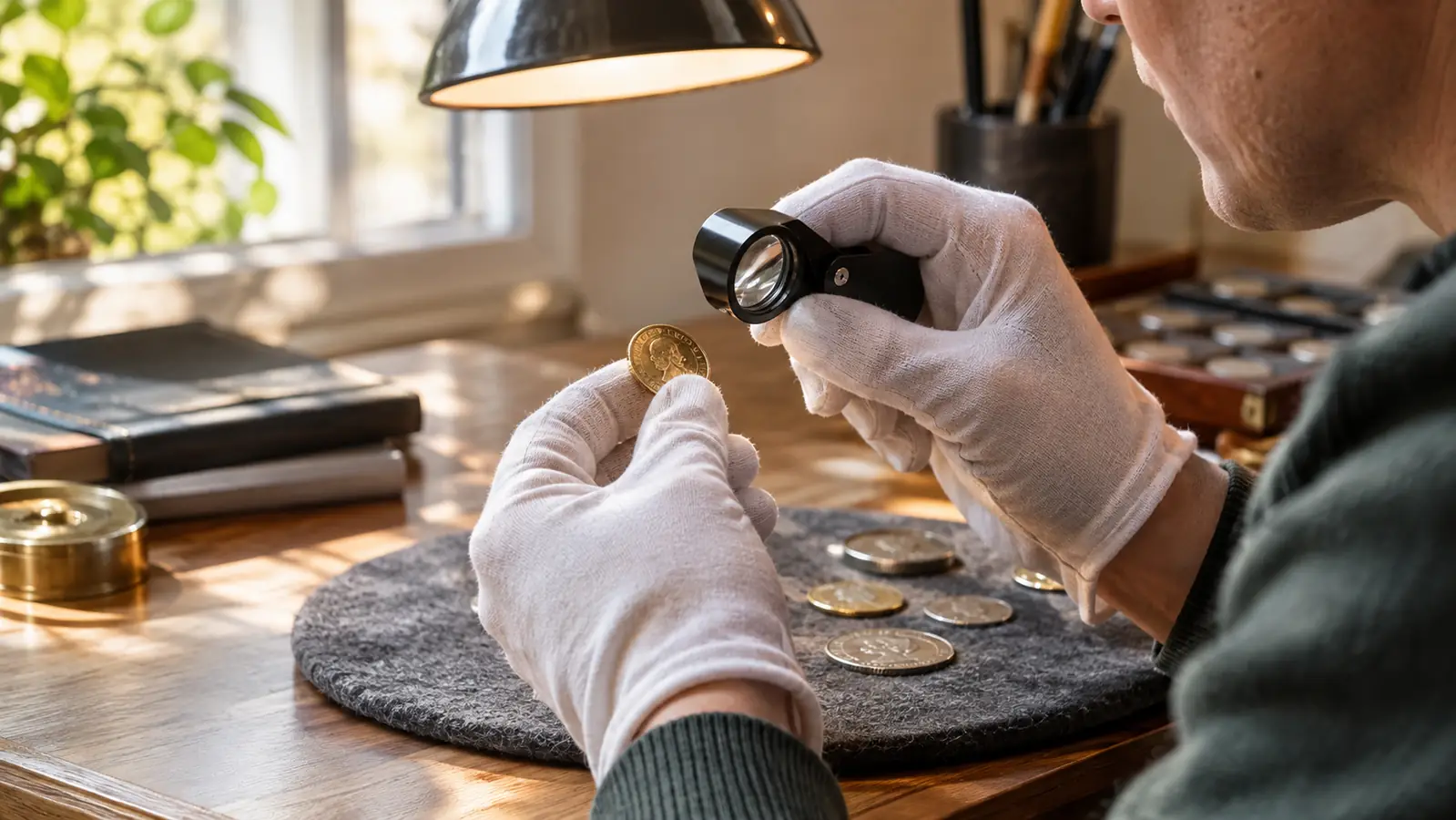
I keep a JARLINK loupe in the top drawer of the folding oak desk in my coin room, next to the felt pad and a pencil. It has been there a little over two years now and I reach for it more than any other tool I own. Not because it is fancy. Because it solves the problem every collector runs into the moment they stop looking at a coin from arm's length, which is that you cannot see what you are actually holding.
My grandfather left me a coffee can of wheat pennies and old nickels when I was twelve. I have been at this off and on for fifty-five years, seriously for the last nine since I retired from teaching shop. In that time I have bought a fair number of bad tools. The JARLINK 30X 60X illuminated loupe is one of the few I would buy again tomorrow. Here are ten reasons it earns its place in the drawer.
The tool I pick up before I pick up anything else
Two lenses, one LED, three LR1130 batteries in the box, and a fabric bag to keep the lenses clean. If you are still squinting at coins under a desk lamp, start here.
Amazon Check today's price on Amazon →The 30X lens shows you what your naked eye smooths over
The primary lens is 30X with a 22mm opening. That is enough power to see a mint mark worn nearly flat, and enough field of view to take in the whole bust of a Lincoln cent at once. Cheap loupes make you choose between the two. Too much power and you are looking at three square millimeters. Too little and you are guessing. I use the 30X for date checks, mint marks, and reading the lettering on a worn Liberty nickel. It is the lens I use nine times out of ten.
The 60X lens answers the question the 30X raises
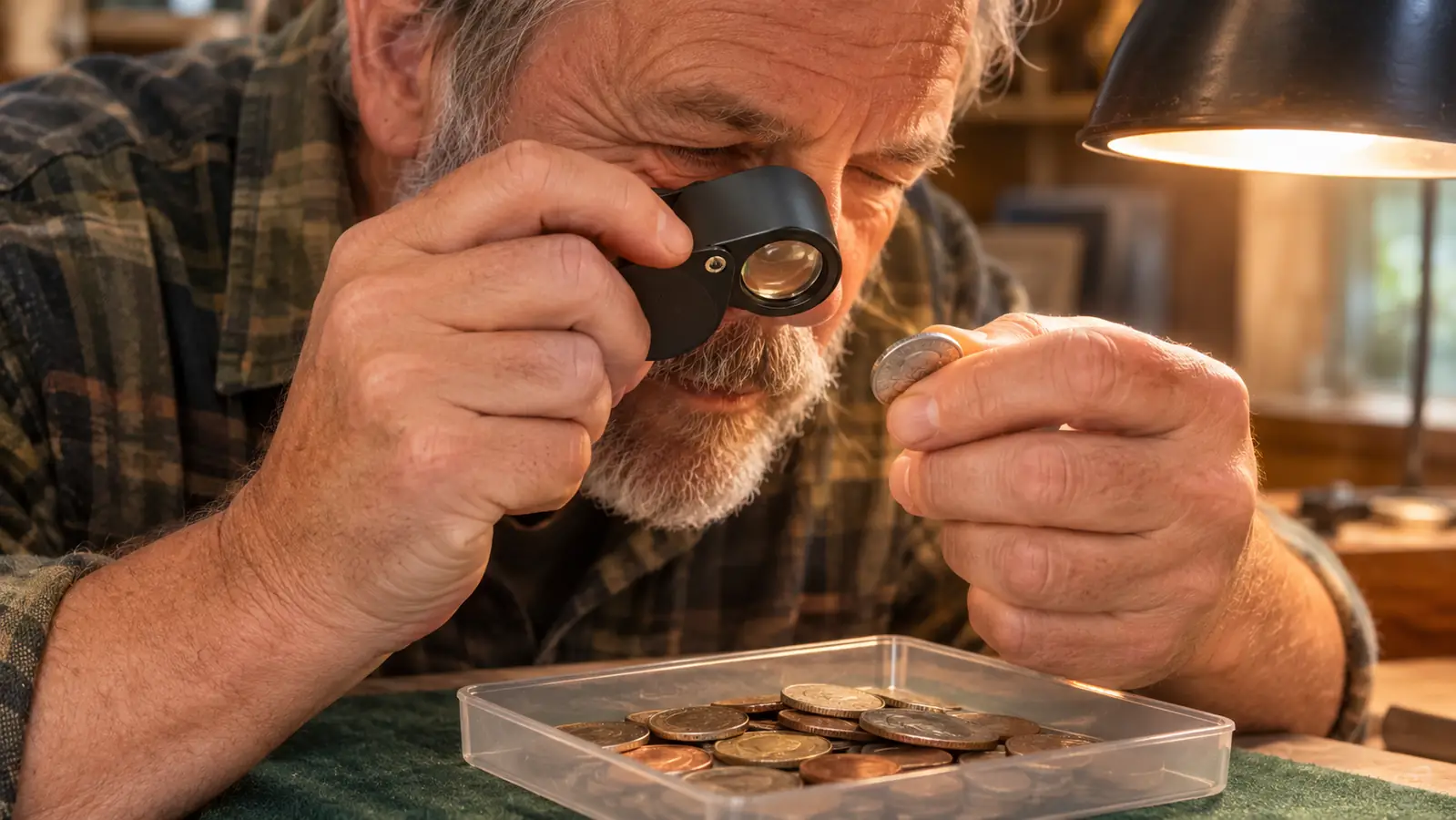
The supplementary lens is 60X with a 12mm opening, and it sits inside the primary lens. When the 30X shows me something odd, a possible die crack or a rim that looks off, I move to the 60X without setting the tool down. The view is narrow, so you have to hunt for your spot. That is the tradeoff with any 60X. But when you want to know whether a line on a coin is a scratch or a variety, there is no substitute for getting closer.
The LED hits the coin at an angle, which is where relief lives
Flat, head-on light flattens a coin. You see the design and nothing else. The LED in this loupe sits to the side of the lens, so the light rakes across the surface and the relief throws a shadow. That shadow tells you whether a mint mark is raised or just a stain, and whether a rim ding is a ding or a trick of the light. I spent years tilting coins toward a desk lamp trying to get that angle. The JARLINK does it while I hold it still.
Battery power means no cord dragging across the felt pad
It runs on battery, three LR1130 button cells, and a set comes in the box. No cord across the felt pad, no unplugging the desk lamp to free a socket. For coin work that matters more than it sounds. A cord catches on the tray, the coin slides, and then you are the fellow who dropped a silver dollar on the floor. Battery power means I carry the loupe from the desk to the kitchen table and back without thinking about it.
At 27.22 grams it does not tire your hand
Twenty-seven grams is light enough to hold up to your eye through a long sorting session. I have used heavier loupes that made my wrist ache after twenty minutes, and a loupe you stop using is a loupe that does nothing. The body measures 1.6 inches long by 2 inches wide, small enough to pinch between thumb and index finger the way you would hold a coin flip. Not a spec I would have thought to care about. One I notice every single time.
That shadow is what tells you whether a mint mark is raised or just a stain. Flat light hides both.

It rides in a shirt pocket to club night
There is a fabric bag in the package and I use it. The loupe goes in the bag, the bag goes in my shirt pocket, and I am out the door to the monthly meeting. Before this I carried a folding magnifier that collected lint and needed wiping down every time I pulled it out. The bag keeps the lenses off the grit that lives in a pocket. Small thing. Small things decide whether a tool comes with you or stays home.
It lets you look before you commit at a bourse table
At a regional show the dealer has the coin in a flip and forty people are behind you. You get a few seconds. A loupe in your pocket turns those seconds into a real look at the rim, the edges, the mint mark, the surface. I am not going to tell you this makes you a better judge of a coin. It does not. What it does is let you see the coin you are being shown, which is the bare minimum before you decide anything about it.
Better light is easier on old eyes
I am sixty-seven. My close vision is not what it was at forty, and I suspect I am not alone in that around this hobby. Working under a lamp with a plain magnifier means squinting and leaning, and after an hour my eyes are tired and my neck hurts. The illuminated lens puts the light where the magnification is, so I sit up straighter and I last longer at the desk. Carol says I complain less. That counts for something.
Resin lenses tell you when to stop handling them
The lenses are resin, not glass. Resin scratches. I keep a microfiber cloth in the drawer and use it before every session, because a scratched lens shows up as haze right where you are trying to look. That is a real drawback and I will not pretend otherwise. On the other side, resin is lighter than glass, which is part of why the whole thing weighs under an ounce. Treat it like a lens and not like a keychain and it holds up fine.
It gives a ten-year-old something real to look at
My grandson Tyler is ten and he sorts pocket change with me on Sunday afternoons. The loupe is the thing that turned sorting from a chore into a job. He finds a beat-up nickel, puts the 60X on it, and wants to know why the date looks doubled and the rest does not. I do not always have an answer. But he is looking closely at something, and that is more than most ten-year-olds do with a coin. It has survived his handling, which is its own kind of test.
What I'd Skip
If you want one thing off the list, it is the idea that you need more power than this. Anything past 60X on a handheld loupe is a view so narrow you spend more time finding the coin than looking at it, and the light has further to travel. I would also skip the loupe with the built-in measuring scale etched across the reticle. It sounds useful until you realize you will never measure a coin with it. And buy one, not three. Keep it in the bag, keep the bag where you sit, and accept that the batteries are the small LR1130 cells you will want a spare set of. Mine has run two years on the originals because the LED only lights while my thumb is on the switch. That is the whole maintenance schedule. Wipe the lens, change the cells eventually, and go back to looking at coins.
Ten reasons, one small tool, one drawer
If you have been tilting coins toward a desk lamp and guessing, this is the simplest fix I know. My JARLINK loupe has lived in the top drawer of the coin room desk for two years and I have not found a reason to move it.
Amazon Check today's price on Amazon →