
The first coin I ever looked at through real magnification was a 1944 Lincoln cent out of my grandfather's coffee can, and I was certain I had found something. Under the glass I could see what looked like doubling in the date. I carried that cent around for a week before a man at the club told me, kindly, that I was looking at a worn die and not a doubled die. I have never minded being wrong in that particular way. What I mind is not being able to see. Four seconds of squinting at a coin in poor light is not an inspection, it is a guess with extra steps.
Most of the collectors I know still check coins with a kitchen magnifying glass, a phone camera zoomed to the point of mush, or a jeweler's loupe from a cheap accessory kit that has a bubble in the lens. None of those will show you a repunched mintmark, or the fine parallel hairlines that tell you a coin was wiped down years ago. What shows you is a loupe with its own light and two honest powers of magnification. That is why there is a JARLINK 30X 60X illuminated loupe on my desk in the coin room instead of in a drawer with the tape measure. It has a 30x22mm primary lens, a 60x12mm supplementary lens, an LED that puts light where the glass is aimed, and it weighs less than an ounce. Here is the order I actually use it in, on cents, nickels, quarters and the Morgan and Peace dollars I have been slowly putting together for nine years.
You cannot read a mintmark through a kitchen glass
Thirty power for the whole face, sixty for the small details, and an LED aimed where the lens is pointed. That is the entire job, and this does it.
Amazon Check Today's Price on Amazon →Step 1: Set the bench before you touch a coin
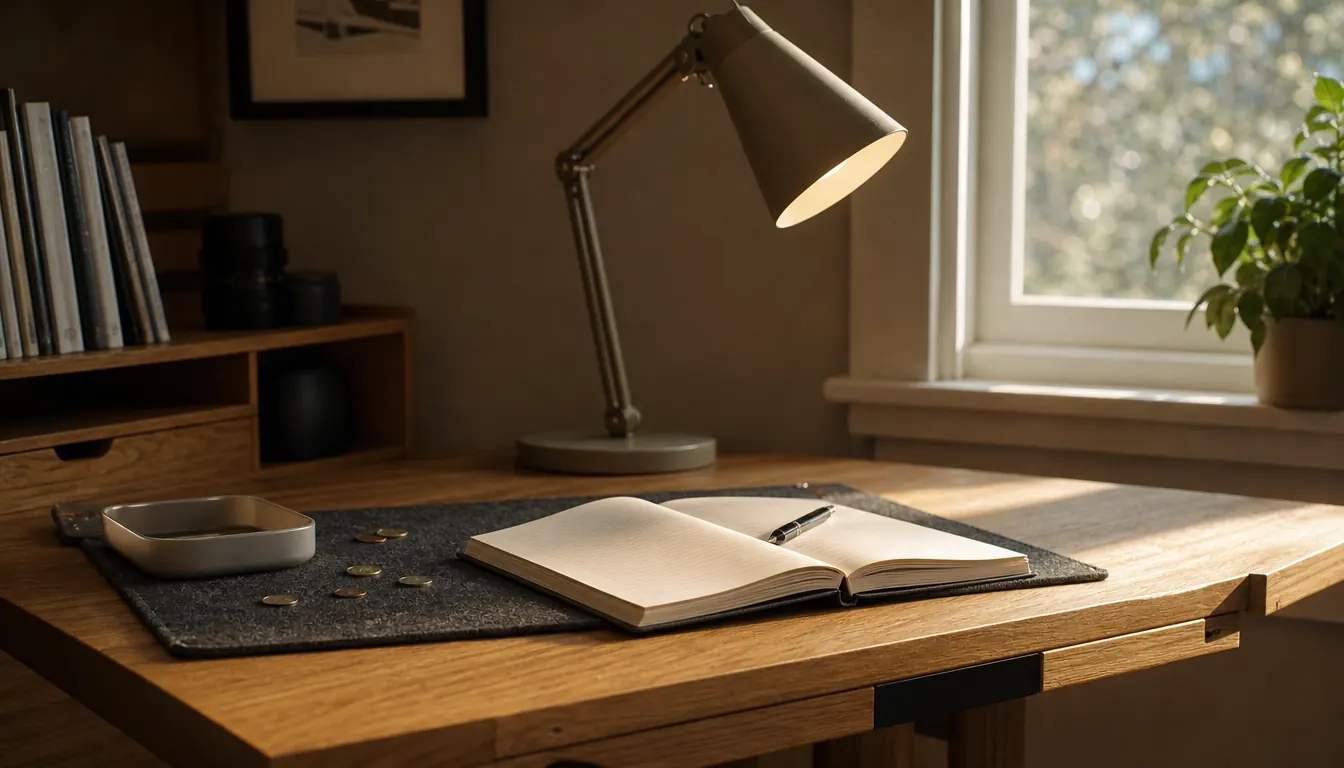
My coin room has a folding oak desk, a desk lamp I can swing around, a felt pad, and a small plastic tray that has caught more rolling cents than I care to admit. Everything I need sits within arm's reach, because the moment you get up to look for something is the moment a coin takes a walk off the edge of the desk. A nicked rim from a hardwood floor is permanent. It cannot be undone, and it will follow that coin for as long as it exists.
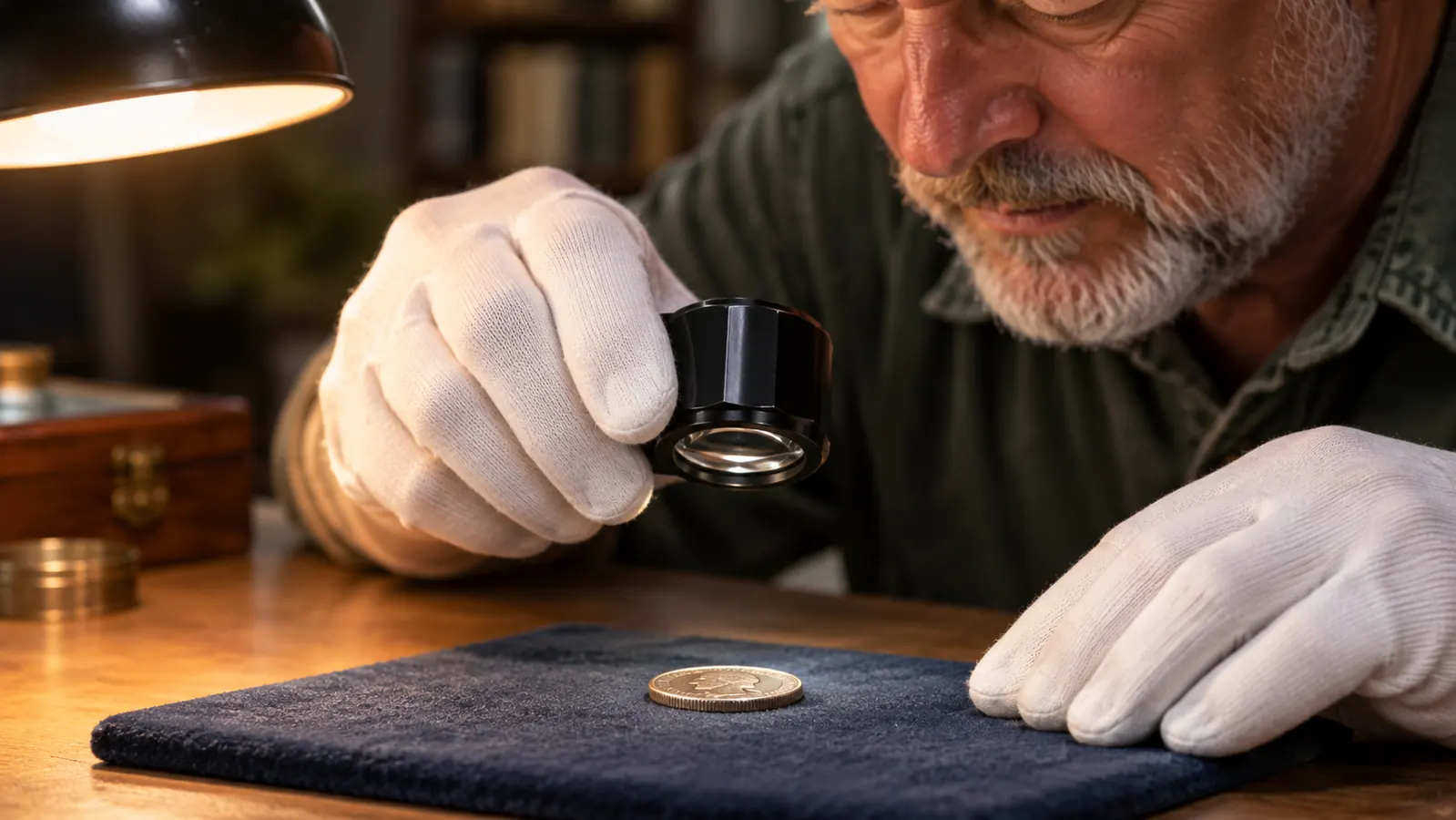
Before anything comes out of the holder, put the pad down and put the tray at the edge of it. Wash your hands and dry them, or put on cotton or nitrile gloves if the coin is uncirculated. Hold the coin by the edges, both edges, between thumb and forefinger, and never slide it across the felt. Sliding is how a coin picks up a fresh line. I know collectors who handle everything bare-handed and I know collectors who glove up for a proof. Both are fine. Dropping a coin is not fine.
The JARLINK loupe itself is about the size of a matchbook, just under an ounce, so your hand does not have to work hard to hold it steady. Three LR1130 button cells come in the bag, along with a small screw. Keep the screw. It is the kind of part that goes missing on a Tuesday and stops the whole session. The fabric bag that comes with it is where the loupe lives when it is not in your hand, and that matters more than it sounds, which I will get to in the last step.
Step 2: Take the whole-coin pass at 30x first
The 30x22mm lens is the one you start with. Twenty-two millimeters of lens at thirty power will take in the full face of a cent, a nickel or a quarter with room to spare, and a dollar coin in two passes. Start at the rim and work inward. Rim first, because rim damage is the most common thing I find and the easiest to miss when you are staring at a date. Then the denticles or the beads, then the fields, then the high points of the portrait, and only then the date.
There is a reason for that order. If the rim is badly dinged or the coin has been harshly cleaned, everything else you are about to do is bookkeeping. You are not going to change your mind about the coin by finding a nice mintmark on a piece with a gouge in the rim. Do the fast, brutal pass first, and then decide whether the coin deserves the next twenty minutes.
Move the loupe, not the coin. Rest your wrist on the desk and slide your hand, keeping the lens parallel to the surface. Tilt the loupe and the edge of the field goes soft, and softness at 30x is easy to mistake for a weak strike. Focus by bringing the loupe closer to the coin and further away, a few millimeters at a time, until the surface snaps in.
Step 3: Switch to 60x for the mintmark and the small details
The 60x12mm lens is a small window, twelve millimeters across, and at that power you are no longer looking at a coin, you are looking at a neighborhood of a coin. Use the 30x to find the mintmark first. Then move to the 60x with the spot already located, because hunting for a two-millimeter letter through a twelve-millimeter window at sixty power is how people give up and decide a coin has no mintmark.
Know where the mintmark is supposed to be before you go looking. On Lincoln cents it sits below the date through 1967 and moves to the right of the bust in 1968. On Jefferson nickels it sat on the reverse for decades and moved to the obverse in 1968. On Morgan and Peace dollars it is on the reverse, under the wreath or under the eagle. I have watched a man at a show declare a coin mintmark-free for ten minutes while looking at the wrong side of it. He was not careless. He was working from memory.
At 60x you are reading the shape of the letter, not just its presence. A crisp S with square serifs and full depth is a different thing from a soft blob that could be an S or a partial punch. You are also looking for a second impression, an S punched slightly off from the first, which is what a repunched mintmark is. And you are looking at the space around the letter, because a mintmark that sits too high or leans is worth a second look against a reference book.
One caution specific to this power: at 60x a fleck of lint looks like a die gouge, a speck of dust looks like a chip, and a slightly worn die looks like a doubled one. When something interesting shows up, move the light, change the angle, and look at it again. If it is still there from three angles, it is on the coin. If it moves, it is on the lens.
At 60x a fleck of lint looks like a die gouge. Look at it from three angles before you believe it.
Step 4: Read the surface with the light at a low angle
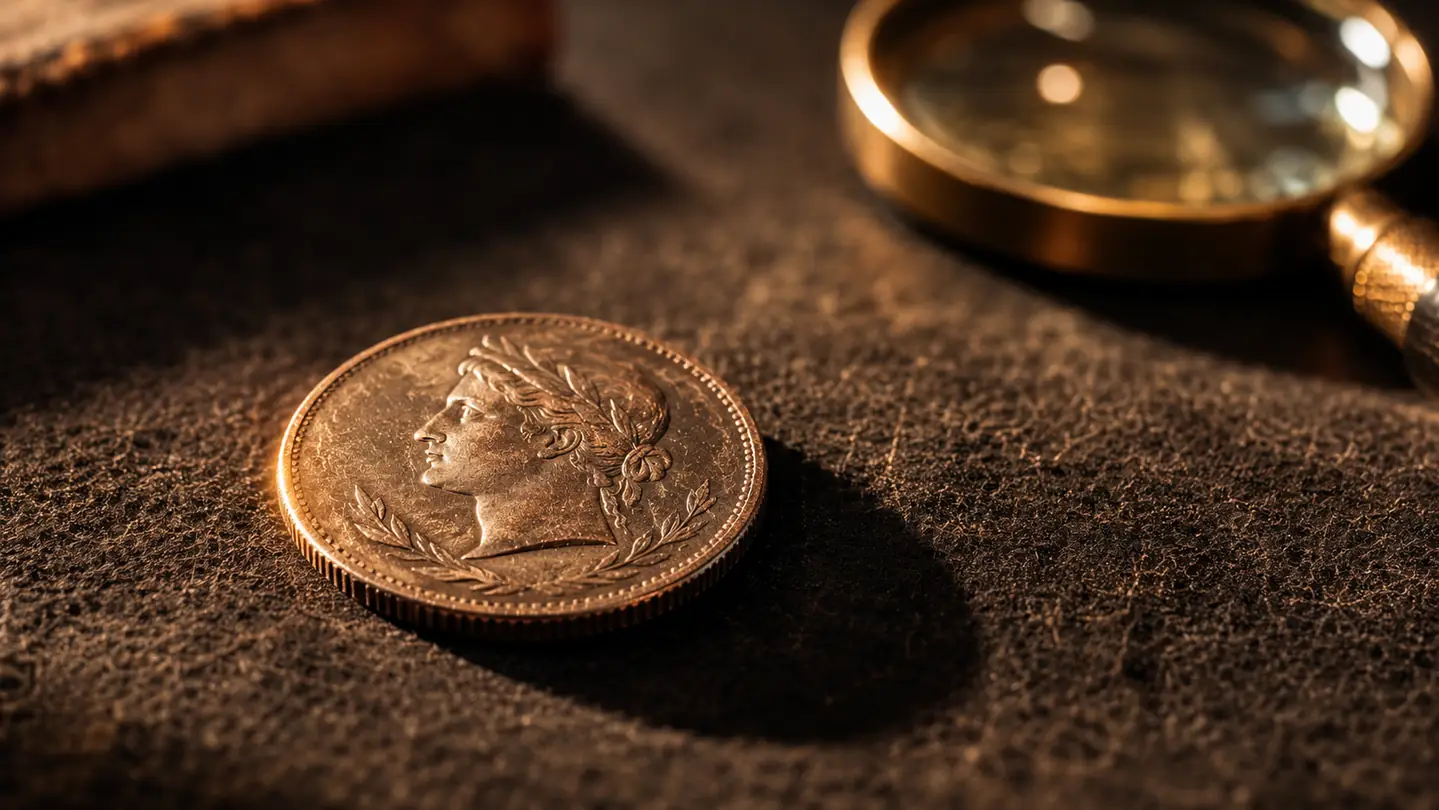
This is the step the LED earns its place. Flat overhead light washes out a coin's surface. What you want is light raking across it, close to parallel with the field, so the smallest raised or recessed line throws a shadow. Turn the coin slowly under the light and watch the field. Hairlines from an old cleaning show up as a family of fine parallel lines, all running the same way, clustered where a cloth would have gone. A single scratch runs its own direction and stops.
That difference is the whole reason I keep a JARLINK loupe with its own light instead of relying on the desk lamp alone. The LED sits right at the lens, so the light moves when your hand moves. I can tilt, sweep and catch a reflection without chasing a lamp with my elbow. On a bright silver dollar the reflection is the tool: bring it up until the field goes almost white, then back off until the lines appear in the glare.
I am not grading anything here and I am not telling anybody what a coin is worth. I look at what is on the surface, I write it down, and I let a dealer or a grading service have the argument. What the loupe gives me is a smaller chance of being fooled, including by myself on a Saturday afternoon when I want a coin to be better than it is.
Step 5: Write it down and put the coin away properly
Every coin that comes out on my desk gets a line in a notebook: the date, the mintmark, whatever I saw, and what magnification I saw it at. It takes ninety seconds, and it has kept me from buying the same coin twice at two different shows, which I have done, and it has kept me honest about a coin's flaws. When I pull that coin out again in two years, my own handwriting tells me where the rim nick is instead of me discovering it fresh and being disappointed all over again.
Then the coin goes back in its holder, edges only, and the holder goes back in the box. Gloves come off. The loupe goes back in the fabric bag, because the lens is resin and resin scratches. Wipe it with a soft cloth, never a shirttail, and never while there is grit on it, because a single grain of dust dragged across a resin lens leaves a permanent line you will be looking through for years. The bag costs nothing and does the job.
Tyler and I sort pocket change on Sunday afternoons, and this is the part of the routine he has picked up without being told twice. The coins go back in the tray, the tray goes in the drawer, the loupe goes in the bag. He is ten and he handles a coin by the edges now. That is worth more to me than any single coin in the room.
What Else Helps
A loupe is the center of the setup, not the whole setup. An adjustable desk lamp you can swing down to a low angle does more for surface inspection than a brighter bulb ever will. A felt pad keeps coins from sliding and gives dropped pieces a soft landing. A shallow plastic tray at the edge of the pad catches the ones that roll anyway, and they do roll, every session, no matter how careful you are.
Cotton or nitrile gloves for anything uncirculated, and clean dry hands for everything else. A 2x2 holder or a capsule for each coin you pull out, so nothing sits loose on the desk while you are writing. A soft lens cloth in the bag with the loupe. And a reference book within reach, because half of what a loupe shows you is only meaningful if you can look up where the mintmark is supposed to sit and how the letter is supposed to be shaped.
The last thing is discipline about magnification. Thirty power first, sixty only when you have a reason. Starting at the highest power you own is how people spend an entire evening on a coin's mintmark and never notice the gouge in the rim. Fast pass, slow pass, then the small details. That is the whole method, and it works the same on a wheat cent out of a coffee can and on a silver dollar in a capsule.
The loupe does not make a coin better. It makes you harder to fool.
Thirty for the face, sixty for the mintmark, light where you point it
The JARLINK 30X 60X loupe lives on my desk, in its bag, ready for the next box of cents. If you are still squinting under a lamp, this is the simplest upgrade to your eyes you will make.
Amazon Check Today's Price on Amazon →