
Last month a fella at the club slid a nickel across the table in a cardboard flip and asked me what it was. Not what it was worth. What it was. He had owned it for eleven years and had never been sure. I turned it over twice, held it under the lamp at an angle, and told him I would know in about ninety seconds. He looked surprised. It was not a trick and I am not that sharp. I opened a book, found the right page, found the right row, and read across it. That is the whole method, and it works on nearly anything you pull out of a coffee can.
The book is the 2026 Red Book: A Guide Book of United States Coins, 79th edition, from Whitman. Four hundred eighty-four pages, nine by six inches, about a pound and a half, and it fits in the drawer of the folding oak desk in my coin room. It has been in print long enough that your grandfather probably owned a copy, and the format has barely moved in all that time because it did not need to. I have used one version or another since I was twelve years old. This is not a pitch. The point is that a good many people own one of these and never learn to read it properly, and a reference you cannot navigate is just a heavy object taking up shelf space.
The Page You Need Is Already In There. This Is How You Find It.
The 2026 Red Book, 79th edition, from Whitman. 484 pages covering US coin series from the early material through modern issues, with the mintmark diagrams, mintage figures and grade columns that answer the question in front of you.
Amazon Check Today's Price on Amazon →Step 1: Read the Date and Name the Series Before You Open Anything
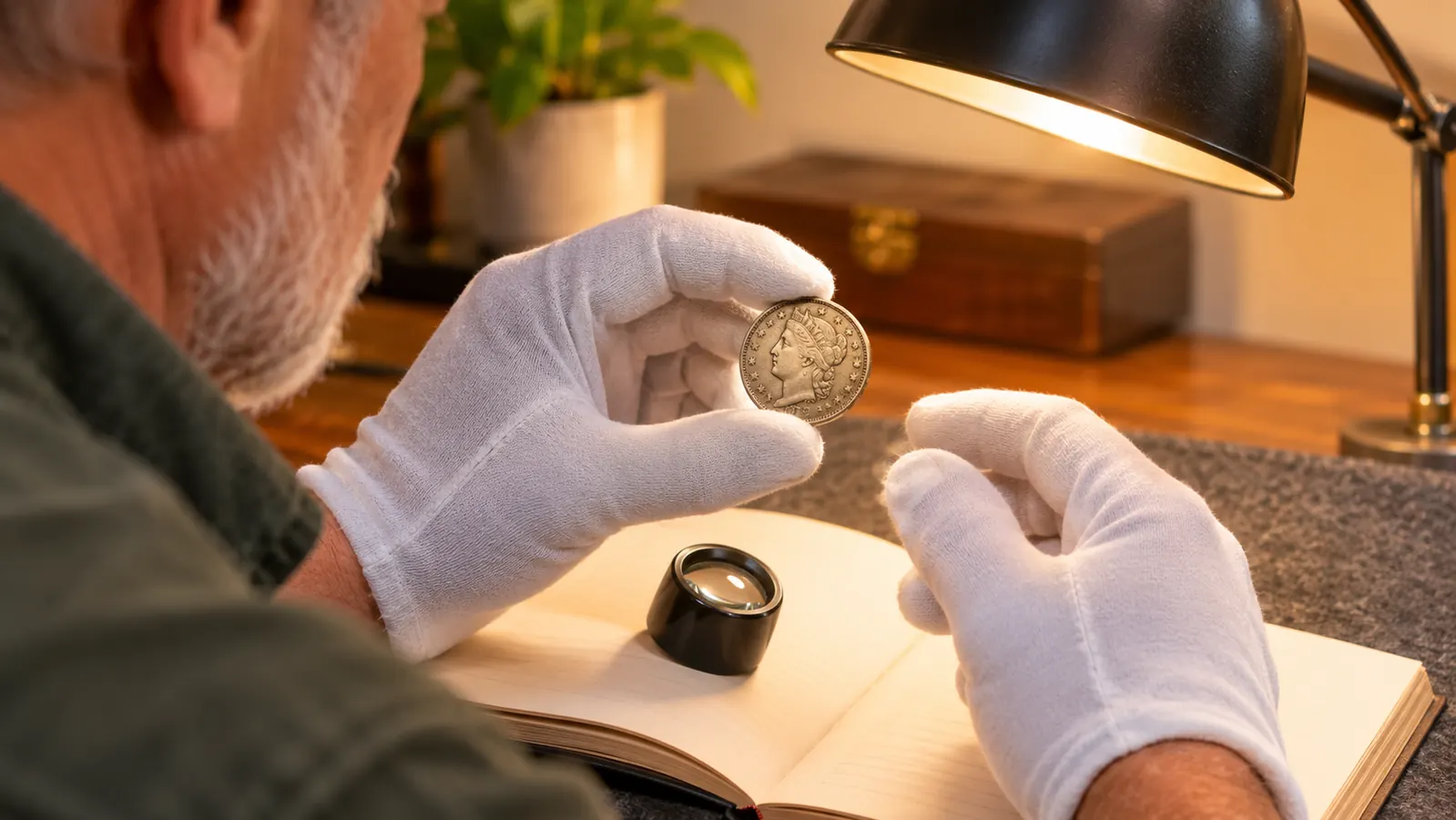
Start with a flat surface and a lamp you can angle. I use a felt pad on the oak desk and a small plastic tray to hold whatever I am working through, so nothing rolls off onto the floor and under a bookcase. Hold the coin by the rim. If it looks uncirculated, put the cotton gloves on first. You cannot read a date through a fingerprint, and you should not be leaving one there in the first place.
Read the date under the light at an angle rather than straight down. On a worn Lincoln cent the last digit is usually the first to fade, so if the coin reads 191 and the fourth digit is soft, do not talk yourself into a number. Set it down and come back with better light or a loupe. A date you guessed is worse than no date at all, because every step after this one leans on it and you will not go back and check your own work.
Then name the series out loud before you open the book. Not old quarter but Standing Liberty quarter or Washington quarter. Not buffalo but Buffalo nickel. The guide is organized by series, so if you cannot name the series you cannot find the page, and if you cannot find the page you will end up on a search engine reading four answers that contradict each other and one that is about a different coin entirely. Naming it takes ten seconds and saves the rest of the afternoon.
Step 2: Find the Right Section in the Right Order
The 2026 Red Book runs in a fixed order and that order does not move much between editions. Cents first, then nickels, dimes, quarters, half dollars, dollars, with the gold pieces and the early material after that. Inside each denomination the series run in date order, so Lincoln cents sit before Indian Head cents when you are flipping toward the front. Use the thing four or five times and your thumb will know where to land before your eyes catch up.
Until then, use the index at the back. Four hundred eighty-four pages is nothing once you know the layout, and it is a fair amount of page turning when you do not. The index will take you from a common name straight into the right section, which matters most for commemoratives, for the odd series you only run into once a year, and for anything a friend hands you across a table at a show when you would rather not admit you are lost.
Open the book flat on the desk and let it lie there. A new binding is stiff, and if you hold it open with one hand while you squint with the other you will crack the spine inside a month. That is one more reason the folding table beats working on my lap. Whitman builds these to be used rather than admired, but used is not the same as abused.
Step 3: Locate the Mintmark and Read It Correctly
Most mints put a letter on the coin and Philadelphia mostly did not, and that silence is itself information. On a Lincoln cent the letter sits under the date on the earlier pieces and to the right of the bust on the later ones. On a Jefferson nickel it sits above Monticello on the reverse for the older years and on the obverse for the newer ones. The book shows where the mintmark sits for each series in a small diagram at the top of the section, and that diagram is the part most people skip and then need twenty minutes later.
Learn the letters before you need them. D is Denver. S is San Francisco. O is New Orleans. CC is Carson City. C is Charlotte, and on the old gold coins D is Dahlonega rather than Denver. W is West Point. Two mints share the letter D depending on the decade, which is exactly the kind of detail that produces a wrong line on an index card you then trust for ten years without ever rechecking.
One wrinkle worth knowing before you get excited about anything. No US coins carried a mintmark in 1965, 1966 or 1967. If you find a quarter from that stretch with a letter on it, treat it as a question rather than a find. Most of the time it is a counterstamp, a damaged planchet, or something altered in a garage forty years ago. The book is where you confirm what should exist before you decide that what you are holding is unusual.
Step 4: Read the Mintage Column for What It Actually Says
Mintage is the number of pieces struck at a given mint in a given year. That is all it is. It is a count, not a verdict. A low mintage is interesting, but it does not automatically mean scarce in the way a collector cares about, because survival matters more than production ever did. Millions of a coin can go to the melting pot, and thousands of a low mintage piece can sit untouched in a canvas bag for eighty years and then turn up in an estate box.
Read that column the way you would read a parts count in a shop inventory. The 1909-S VDB cent has a mintage of 484,000. That is a small number next to the hundreds of millions of plain 1909 pennies, and it is the reason that coin gets talked about at every club meeting I have ever sat through. But the mintage line is the beginning of the question, not the answer, and the book does not present it as anything more than a count.
Proofs are listed separately from business strikes in most series, and in much smaller numbers. Do not compare the two columns directly. If you do, every proof coin in your box will look like a rarity and you will spend a Saturday afternoon being excited about nothing at all. Read the heading above a column before you read the figure underneath it. That habit alone will keep you out of most of the trouble a beginner wanders into.
Step 5: Read Across the Grade Columns, Then Write It Down
To the right of the date and mintmark row you will find the grade columns, running from heavily worn up through Mint State. You read across the row, not down the page. Find the date, find the mintmark, follow that row to the column that matches the coin in your hand. It sounds obvious written out, and it is the single habit that clears up most of the confusion people bring to a club meeting.
Match the grade honestly and, when you are unsure, take the lower column. The book explains what the grades mean in plain language near the front, and that explanation is worth ten minutes before you start assigning numbers to your own coins. Nearly everybody grades their own material a step or two high at the beginning. I did it for years. The coins did not improve while I was doing it, and neither did my notes.
Then write the whole thing down. I use a 3 by 5 index card for anything that stays in the collection: date, mintmark, mintage, page number, and the day I looked it up. Drop it in the flip or keep it in the box alongside the coin. Two years from now you will not remember which nickel was the 1950-D, and looking it up again is only ninety seconds if you still trust your own notes enough to bother.
What Else Helps
A loupe, and a modest one. Ten power is plenty for reading a mintmark and for settling an argument with yourself about whether that worn digit is a 4 or a 9. You do not need the expensive glass to do this work. If you find that you do need it, you will know soon enough, and somebody at the club will tell you so before you spend anything.
Raking light. Angle the lamp so the beam skips across the surface instead of landing flat on it. Straight-down light hides a mintmark in the shadow of a rim and flattens a date until it reads like a smear of nothing. Ten seconds of moving the lamp around will save you ten minutes of squinting and a headache that follows you to dinner.
A pencil and index cards rather than a pen and sticky notes. A pencil can be corrected, and a card survives being dropped in a box, sat on, or handed across a table. My grandson Tyler sorts pocket change with me on Sunday afternoons and he has read more of my cards than I have. He also asks sharper questions than I did at that age, which is how I ended up explaining a mintmark diagram to a ten year old over a bowl of cereal.
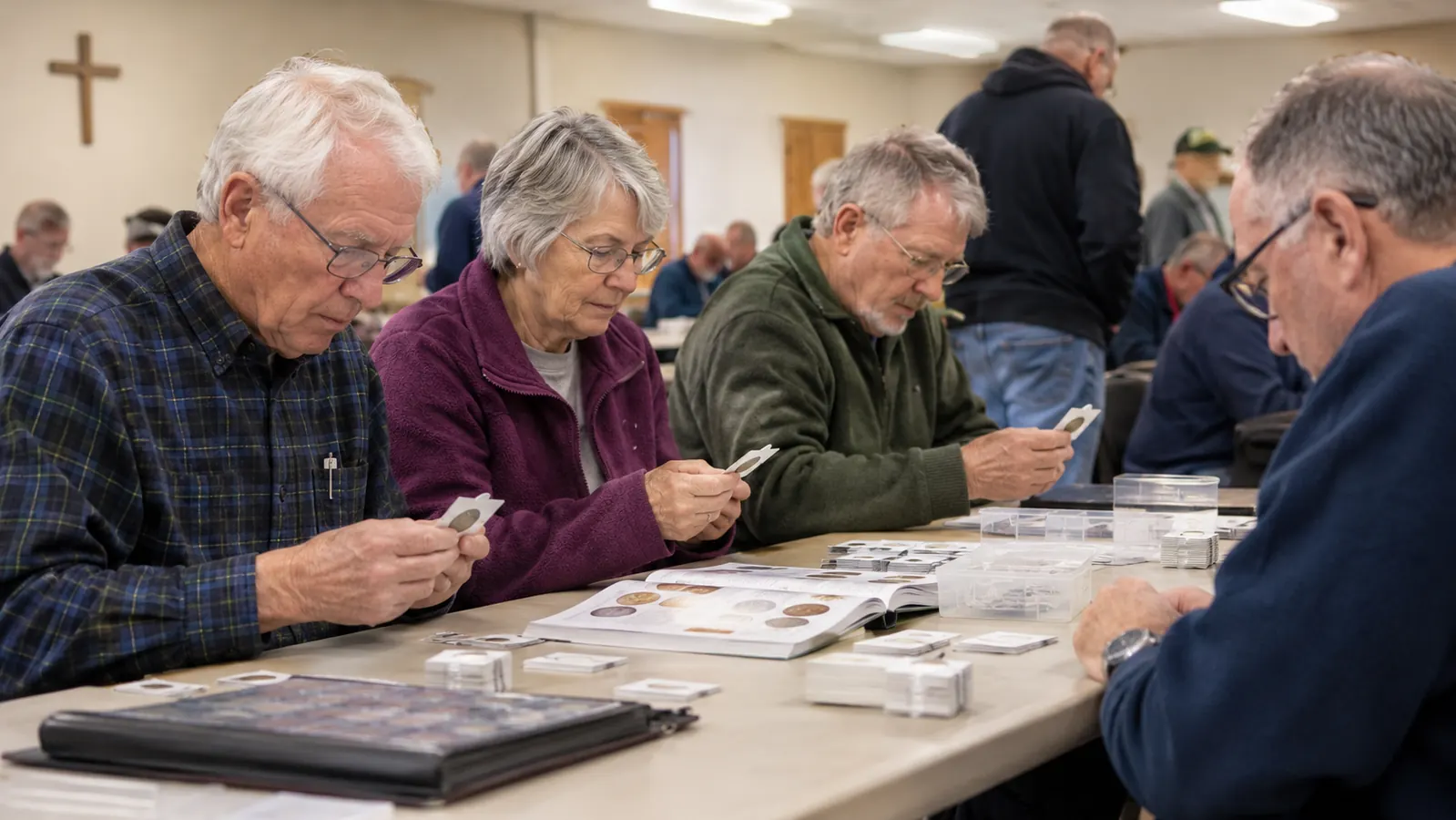
Bring the book to the meeting. Half of what I know about this hobby came from somebody older pointing at a page and telling me to look at the mintmark diagram again. The 2026 Red Book from Whitman is one informed opinion on grade and value, not the last word on either, and a room full of people who have handled coins for forty years will sharpen it in a way no single volume can. A reference you leave at home is a reference you end up arguing with.
A cheap kitchen scale is not a bad addition if you keep silver dollars. Wear removes metal, so a dollar that weighs light has been around and has probably been cleaned at some point. That is not proof of anything on its own, but it is one more data point, and it takes ten seconds to check before you write a note you will believe for a decade.
The 1909-S VDB cent has a mintage of 484,000. That is a small number next to the hundreds of millions of plain 1909 pennies, and it is the reason the coin gets talked about. But the mintage line is the beginning of the question, not the answer.
Ninety Seconds a Coin, for the Next Four Hundred Eighty-Four Pages
One reference, one page, one row. The 2026 Red Book, 79th edition, from Whitman, sitting open on the desk where you can actually reach it.
Amazon Check Today's Price on Amazon →