
A coin only gets handled badly once. That is the part that took me the longest to learn. My grandfather left me a coffee can of wheat pennies when I was twelve, and I spent that first winter dumping them out on the kitchen table and sorting them with bare hands, mostly because nobody had told me there was another way to do it. Fifty-five years later I can still find the prints I left on the better ones. They are faint, brown, and permanent.
So I do it the boring way now. Cotton gloves, one coin at a time, edges only, everything over a felt pad. The gloves I keep in the coin room are Zealor cotton gloves, a pack of twelve pairs, and the routine around them matters more than the gloves themselves. A pair lives in the desk drawer. A pair sits in the plastic tray. The rest stay in a mesh bag in the closet, clean and folded, waiting their turn. None of it is clever. It is six or seven small motions done in the same order every session, until your hands stop needing instructions.
Twelve pairs means you never reach for a dirty one
Zealor cotton gloves, size large at 9.2 inches, washable and reusable. I keep four pairs in rotation and the rest in the closet, so a clean pair is always within reach of the tray.
Amazon Check today's price on Amazon →If you already own a pack and it is sitting in a drawer somewhere, this is the order I would put it to work in. If you do not own one yet, the gloves are the easy part to buy. The technique is the part that takes a season of practice.
Step 1: Wash the Gloves Before They Touch a Single Coin
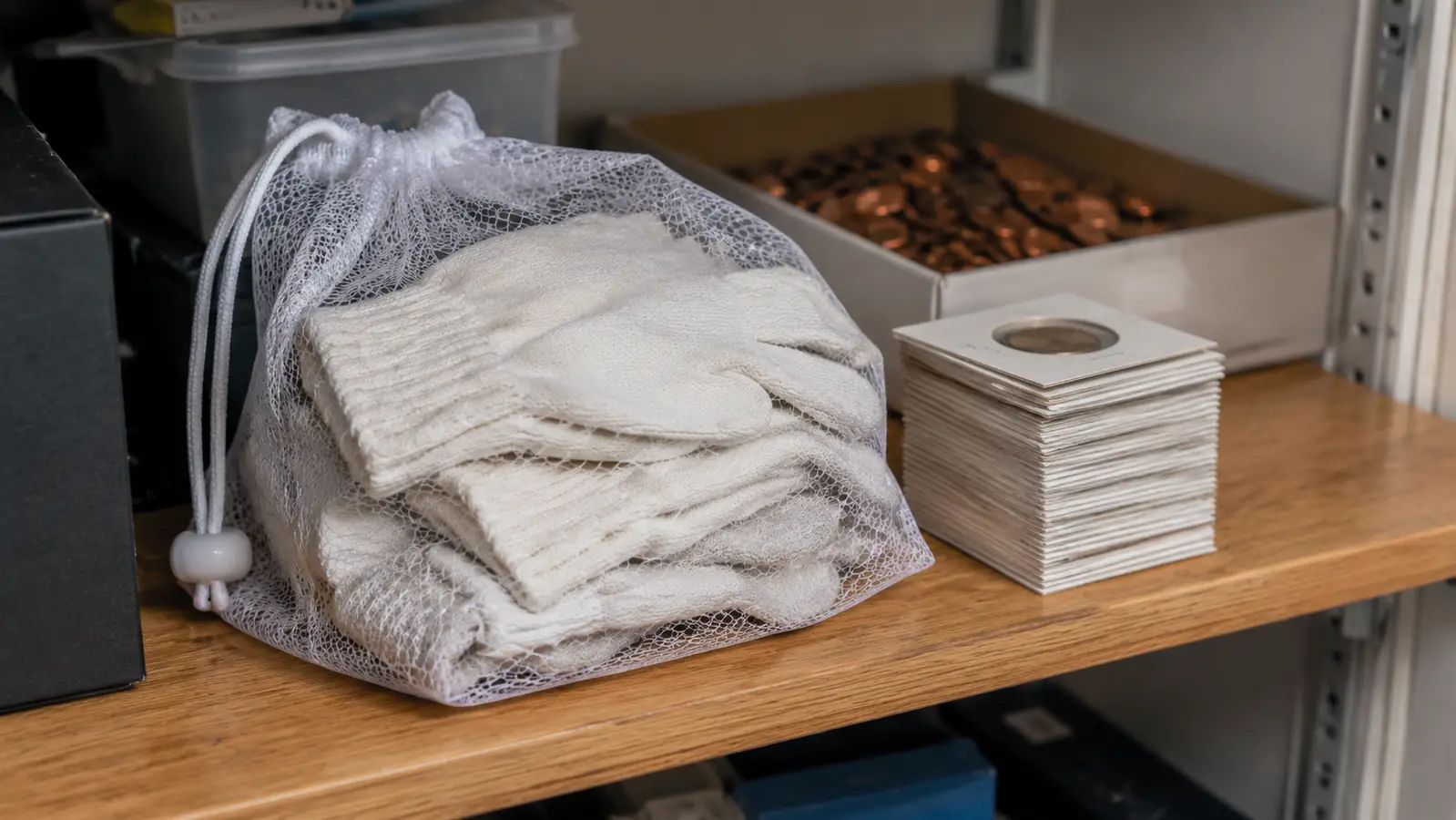
New cotton gloves come out of the package with sizing and dust in the weave, and the first thing that dust does is find the surface of whatever you pick up. So the first pair gets washed before it goes anywhere near the coin room. Warm water, a drop of mild detergent, no fabric softener, and into a mesh laundry bag first so the pair does not wander off in the machine. The Zealor listing specifically mentions laundering in a mesh bag, and that matches what I have found. Loose in the drum they stretch and pill. Bagged, they come out the same size they went in. Air dry them flat. A hot dryer is what turns a soft glove into a stiff one.
I keep four pairs in rotation so I am never waiting on laundry. Two in the drawer, one in the tray, one in the wash. When a pair starts leaving lint on a dark coin, it goes to the back of the line. If a pair has been used for anything else, dusting, polishing, the garage, it never comes back to the coin room. That is not fussiness. A glove that has held a polishing cloth has abrasive in it, and you will not see what it did to a coin until you tilt the coin under the lamp.
Once you have washed everything that came in the pack, sort the pairs into jobs. Raw coins get one pair. Flips, holders and the loupe get another. If you have a pair you use for cleaning a coin, and I would rather you did not clean coins at all, that pair is retired from the coin room the same day. Twelve pairs sounds like more than one person needs. It is not, once you stop washing a pair every single session.
Step 2: Check the Fit at the Fingertips, Not the Wrist
The listing gives a size large at 9.2 inches long and 3.4 inches wide, one size fits most, and that has held true for my hands and for Carol's, though the pair is looser in the palm on her. The measurement that actually matters is at the fingertip. Put the glove on, then pinch a single cent off the felt pad. If the fabric bunches ahead of your finger, you will fumble a coin eventually, and fumbling is how coins end up on the floor. If the fingertip is snug enough that you can still feel the reeded edge through it, you are set.
Two things to settle before you start. Take rings off, both hands. A ring under a cotton glove is a hard edge you cannot see, and it will find the face of a coin sooner or later. Keep your nails short and filed for the same reason. And keep a spare pair within reach, because a glove that picks up a spot of something mid-session is done for the day, and changing pairs takes ten seconds while a smudge on a coin takes a lot longer than that.
The fabric is light, and light is the whole point. A heavy work glove would protect the coin from you and you from the coin, but you would be handling something you cannot feel, and you would set it down harder than you meant to. The gloves are cut for left and right and a fresh pair feels the same on either hand, which sounds trivial until you have twelve pairs in the rotation and no time to sort them.
Step 3: Pick the Coin Up by the Edges, Every Time
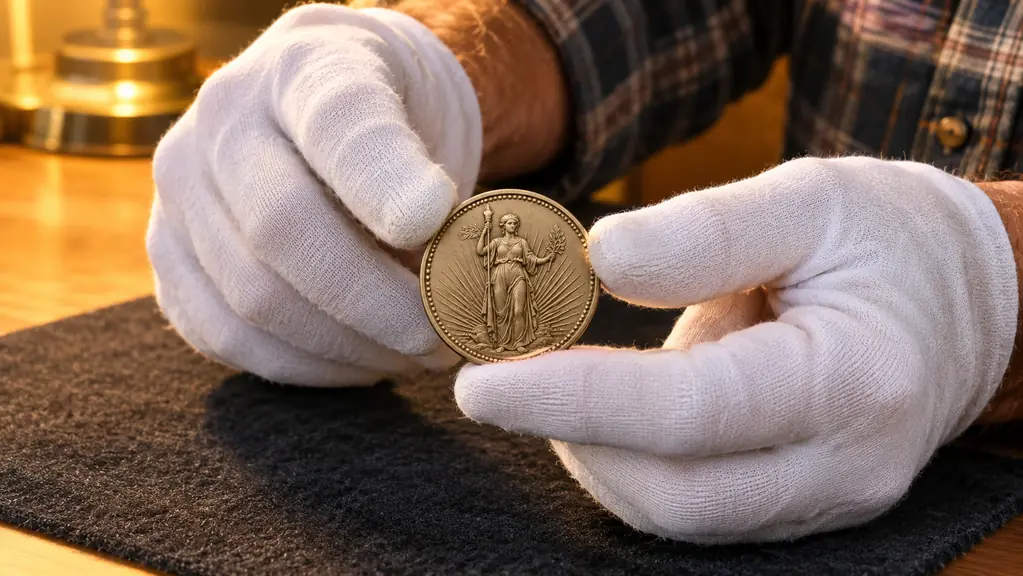
Two fingers on two opposite edges, thumb and forefinger on the rim, coin vertical, faces toward you and away from your palm. That is the whole grip. On a large silver dollar I use the thumb and middle finger on the rim and let the forefinger steady the top edge, because a Morgan is heavy enough that a two finger pinch feels insecure at first. For a cent, thumb and forefinger is plenty. What you never do is press a thumb across the face, even with a glove on. The glove sits between your skin and the metal, not between your habits and the metal.
Here is what bare hands actually do, without the drama. Skin carries oil and salt, and it carries sulfur from the air, and copper and silver both react to sulfur over years. I am not going to tell you that one fingerprint destroys a coin. On a circulated wheat cent pulled out of pocket change it barely matters, and I still handle those however is convenient. On an uncirculated coin, the print sits in the field and darkens, and it is still there in twenty years when somebody else owns the coin. The glove costs you nothing. The print costs you surface.
One more thing about the grip. Never slide a coin across a surface to pick it up. Sliding puts the whole face in contact with the felt, and any grit in the felt goes along for the ride. Walk your fingers under the rim and lift. If a coin is in a cardboard flip, hold the flip. If it is in a hard plastic slab, hold the slab and never the coin through the window.
A cotton glove does not improve a coin. It just means the next person who owns it sees what the mint made instead of what my hands did.
Step 4: Work Over a Pad, and Set the Coin Down Flat
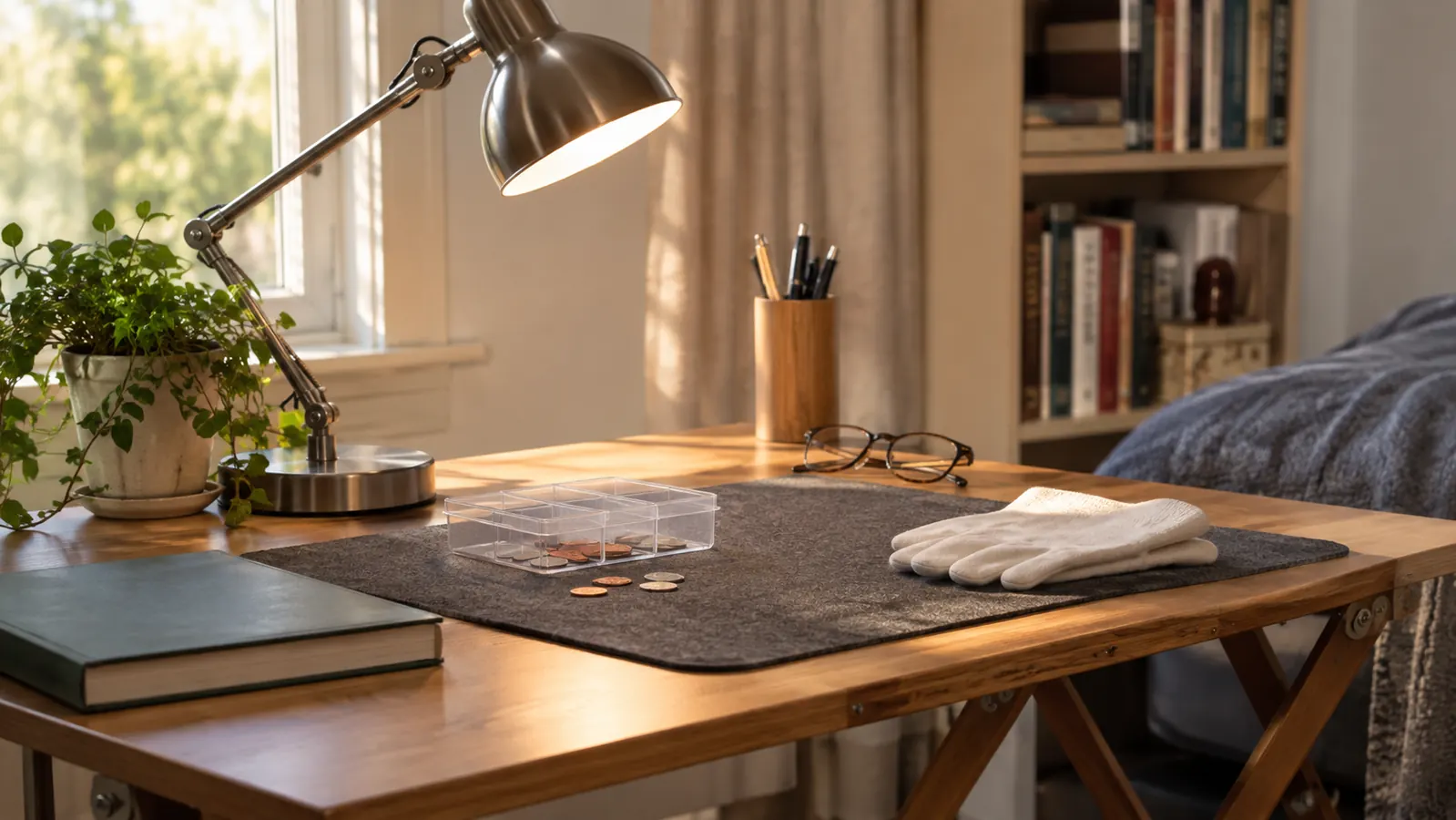
My desk in the coin room is a folding oak one, and oak is exactly the wrong surface for a coin. So the top of it is covered. A felt pad in the middle, a small plastic tray to the right, the desk lamp over my left shoulder. The pad is where coins land. The tray is where they wait while I am looking at something else. Nothing ever goes on the bare wood, and nothing gets stacked, because a stack is just a set of coins resting their weight on each other's faces.
The other rule is that a coin goes down flat and comes up the same way. Not propped on its edge against the tray wall, not rolled to the edge of the pad, not balanced on top of a flip. I have lost one coin in fifty-five years that way, a 1921 Peace dollar that rolled off the pad and landed face down on the floor. It is still in my collection. It has a mark on the cheek that was not there before, and every time I take it out I remember exactly how it happened.
Keep the pad clean, too. Felt picks up dust and hair and holds it, and then every coin you set down gets a small rotation against whatever the felt is holding. I brush mine off with my hand at the start of a session and replace it when it starts looking fuzzy. A pad is the cheapest thing on the desk and the one I replace most often.
Step 5: Take Them Off Properly and Keep the Rotation Clean
Gloves come off at the cuff, not the fingertip, and they come off before you touch anything else. The lamp switch, the doorknob, the coffee cup. Twelve pairs in the pack means you can afford to be strict about that. One pair for raw coins, one for flips and holders, one for the loupe and the scale, and the rest clean and waiting. When a session ends, the pair that was on my hands goes into the wash bag, and the next session starts with a fresh pair out of the drawer.
Store them dry and flat somewhere that is not the garage. A cotton glove left in a hot car or a damp basement picks up a smell and a stiffness that washing does not fully take out, and you will not want it against a coin after that. Mine live in the mesh bag on a closet shelf with the spare flips. It is not an archival setup. It is a dry shelf, and a dry shelf is most of the battle.
What Else Helps
The first addition is light. A desk lamp you can angle matters more than people expect, because most of what you are checking for shows up at an angle and disappears under direct overhead light. I use a small lamp on a flexible neck and I move the lamp rather than the coin. Moving the lamp keeps the coin on the pad, which is where it belongs.
The second is your hands, before the gloves go on. Wash and dry them, and skip the lotion. Lotion works through cotton in a way that surprises people and leaves a film behind. If a coin is genuinely delicate, an uncirculated key date or a proof, nitrile is the better choice and I use it for those. Cotton for everything else, because it breathes and you can wear it for an hour without your hands going damp inside it.
The thing I would not do is turn the whole hobby into a handling drill. Tyler, my grandson, sorts pocket change with me on Sunday afternoons, and we do not glove up for a pile of circulated quarters and nickels. Those coins have been through vending machines and parking meters and a decade of pockets, and a glove is not going to change what they are. Gloves go on for the uncirculated material, the silver dollars, and anything headed into a flip to stay. The point of the routine is to protect the coins you are keeping, not to make handling your own collection a chore you start avoiding.
If you take one thing from all of this, take the order. Wash the gloves, check the fingertip, lift by the rim, work over the pad, fresh pair next time. It takes about a week to stop thinking about it, and then it is just how your hands work at the desk.
Keep a clean pair within reach of the tray
Zealor cotton gloves, 12 pairs, size large, lightweight and reusable after laundering in a mesh bag. Rated 4.5 stars by more than 4,000 buyers. Four pairs in rotation covers a full season of Sunday sorting.
Amazon Check today's price on Amazon →