

Short answer: it depends on the coin, not on the person. For anything uncirculated, for a proof, and for every silver dollar in my set, I wear cotton gloves. For a coffee can of wheat pennies that my grandson Tyler and I are sorting on a Sunday afternoon, clean bare hands are faster, and I do not apologize for it. I am Arnie Szabo. I am 67, I taught high school shop for most of my working life, and I have been handling United States coins since my grandfather handed me a can of them when I was 12. The rule I finally settled on is not really a rule about gloves versus no gloves. It is a rule about what is on your hands while your mind is somewhere else.
The gloves on my desk are the Zealor cotton gloves, twelve pairs to a pack, cotton and polyester, size large, 9.2 inches from wrist to fingertip and roughly 0.15 inches thick. They are not the reason a coin stays nice. The reason a coin stays nice is that you stopped touching it with bare fingers. The gloves are the thing that makes stopping easy, and twelve pairs means you never have an excuse to reach for a dirty one. They go into a mesh bag in the laundry and come back out fine.
| Zealor Cotton Gloves | Clean Bare Hands | |
|---|---|---|
| Barrier between skin and metal | Cotton and polyester between your fingers and the field | Nothing at all. Oils and salts land straight on the surface |
| Grip on a large silver dollar | Cloth slides a little on a bright rim until you learn to cradle it | Fingertips read the reeding and nothing slips |
| Picking one cent out of a pile | Fabric bunches at the tips until it softens with washing | No adjustment needed. You just pick it up |
| Feel for grading | Touch is dulled, so you take the glove off or work under a loupe | Direct contact and full feedback |
| Lint on the field | A new pair can shed a fiber until it has been washed once | No fibers at all, as long as your hands are clean and dry |
| Cushion if you fumble | A thin cloth layer softens a knock against the tray edge | Nothing between a thumbnail and the field |
| Keeping your hands off mid-session | Gloves stay on, so you skip your face, your coffee cup and the mail | Hands dry out, you reach for the mug, you come back to the tray |
| Upkeep | Washable in a mesh bag, twelve pairs to a pack | Wash your hands and own nothing else |
| Best for | Uncirculated coins, proofs, silver dollars, anything going into a holder | Circulated sorting, pocket change, bulk wheat cents |
Where Cotton Gloves Win
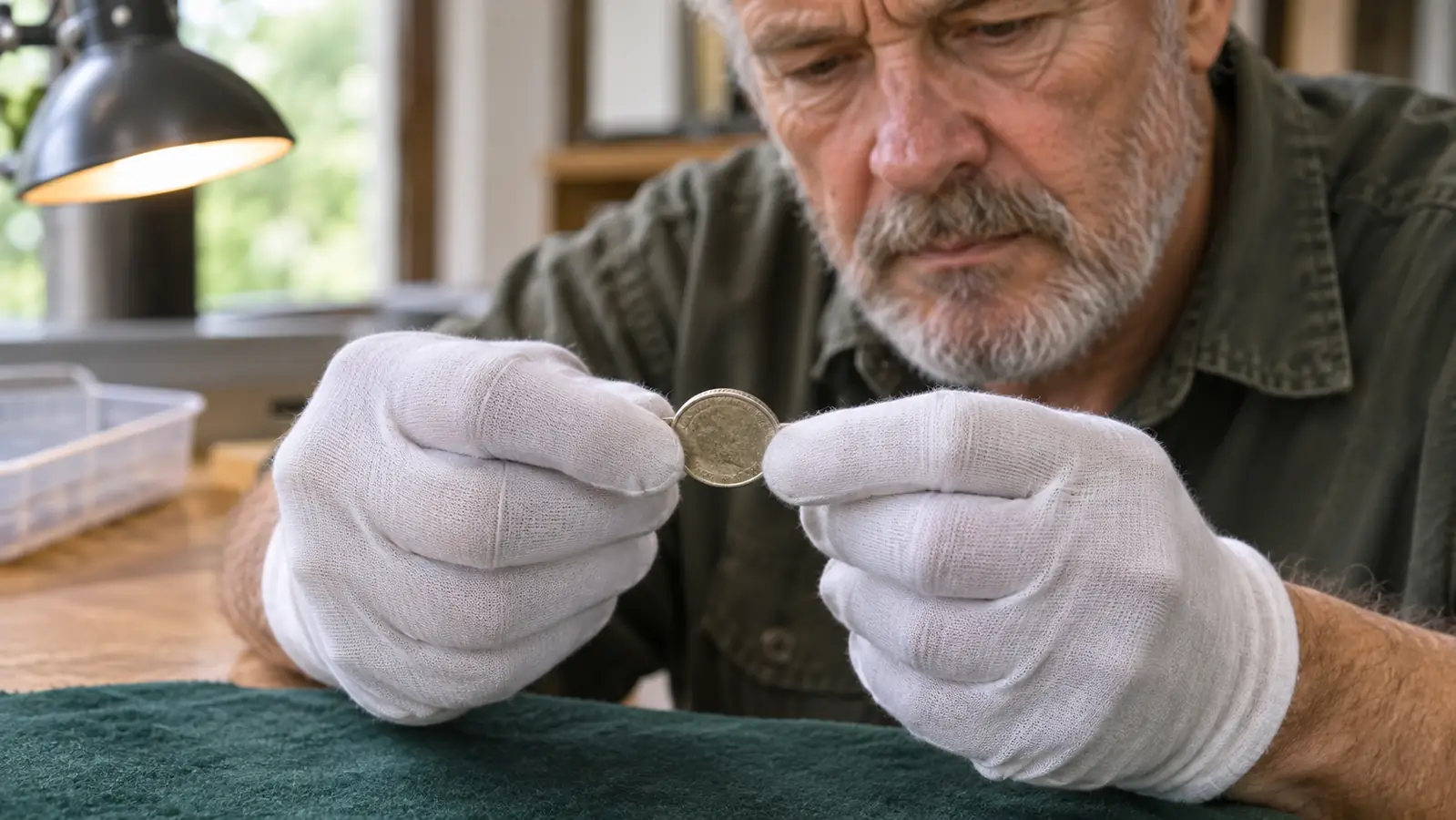
The first win is the boring one, and it is the only one that matters over a lifetime of handling. Your skin puts out oil and salt all day long, and neither of those does a coin any favors. On a circulated coin that has already been through a hundred hands, a fingerprint is nothing. On a coin that still has its original surface, a fingerprint sits on the field like a smudge on a window, and if it stays there long enough it can etch in. The Zealor gloves put cotton and polyester between your fingertips and the metal. That is the entire job. They are not doing anything clever, and they do not need to.
The second win is the one I did not expect. A glove changes your habits. When I am bare-handed at the tray, I touch my face, I pick up my coffee cup, I open the mail, and then I come back to the coins carrying whatever I picked up along the way. With a glove on I do none of that, because I would have to take the glove off first, and taking it off is just enough friction to make me not bother. There is a smaller win too. A 0.15 inch layer of cloth softens a fumble. I have knocked a nickel off the edge of the tray more than once, and I would rather it hit the felt through cotton than straight off a thumbnail.
The third win showed up on a Tuesday in February, about three years back, when I sat down to put a run of nineteen Morgan dollars into new holders. That is a two-hour job if you do it carefully, and I had done the first four or five of them bare-handed the week before, setting each coin on the felt between steps. By the time I finished that first batch my hands were dry from handling the felt and I had already caught myself resting two fingers on a field while I fumbled with a staple. With the gloves on for the second batch, the whole job went cleaner and, honestly, quicker, because I stopped thinking about where my hands were and started thinking about the holders. I also stopped leaving the desk. Two hours is a long time to sit still, and the glove kept me in the chair.
Where Clean Bare Hands Win
Bare hands win on feel, and they win it outright. A glove dulls your sense of touch enough that you cannot grade through it. When I want to look at a coin properly, I take the glove off, or I set the coin on the felt and use a loupe without picking it up at all. There is also the matter of grip. A large silver dollar in a fresh cotton glove will slide a little, and if you are not paying attention you will find yourself chasing it across the desk. Fingertips on the reeding do not slide. For picking one wheat cent out of a pile, gloves are simply slower, and the fabric bunches at the tips until it has been washed a couple of times and softened up.
The other honest point in favor of bare hands is lint. Cotton sheds. A brand new pair can leave a fiber sitting on a mirrored field, and you will spend five minutes with a blower getting it off. Wash the gloves once before you use them on anything nice and that mostly stops, but it is a real tradeoff and I will not pretend otherwise. And here is the part that gets left out of a lot of collecting advice. A clean, dry, bare hand on a circulated 1944 wheat cent is not doing damage. That coin has been in pockets, in parking meters and in a coffee can for eighty years. Your thumb is not the problem.
There is one more thing bare hands give you that nobody talks about, and that is speed on a big sort. Tyler and I do the coffee can on Sunday afternoons, and there are usually somewhere north of four hundred coins on the felt by the time we are done. Four hundred coins is not four hundred decisions, it is four hundred small motions, and a glove turns every one of those motions into a slightly longer motion. The first Sunday I tried it with gloves on I got through maybe a third of the pile before I gave up and finished bare-handed. The coins in that can are all circulated wheat cents and old nickels that have been sliding past each other for decades. Nothing I do to them with a clean thumb is going to register.
You do not need gloves for every coin. You need them for the good ones.
Zealor cotton gloves, twelve pairs, cotton and polyester, size large, 9.2 inches. Wash them in a mesh bag, keep a clean pair on the desk, and stop handling your uncirculated coins with bare fingers.
Amazon Check Today's Price on Amazon →What Cotton Does and Does Not Do
It does not clean anything. A glove will not lift a spot off a coin, will not brighten a dull surface and will not change a grade. If someone told you that handling a coin in cotton gloves improves it, that person was wrong. What the glove does is prevent the thing that makes a coin worse, and that thing is you. Oils, salts and the small amount of moisture that travels with them transfer on contact, and a coin that sits in a holder with a fingerprint on it has a fingerprint on it for good. Cotton is a soft absorbent barrier that is easy to launder and easy to replace.
The other thing cotton does not do is protect a coin from a bad holder, a damp basement, or a soft plastic flip left in a shoebox since the 1980s. Those are separate problems with separate answers, and I have made all of those mistakes at one time or another. I had a shoebox of silver dollars in the basement for the better part of a decade, and the gloves I owned at the time did nothing about the humidity down there. Gloves are one link in a short chain. They only matter if the rest of the chain is in place.
A glove will not clean a coin, brighten it or change its grade. All it does is keep your fingers off it while you work, and it turns out that is most of it.
Where the Two Overlap
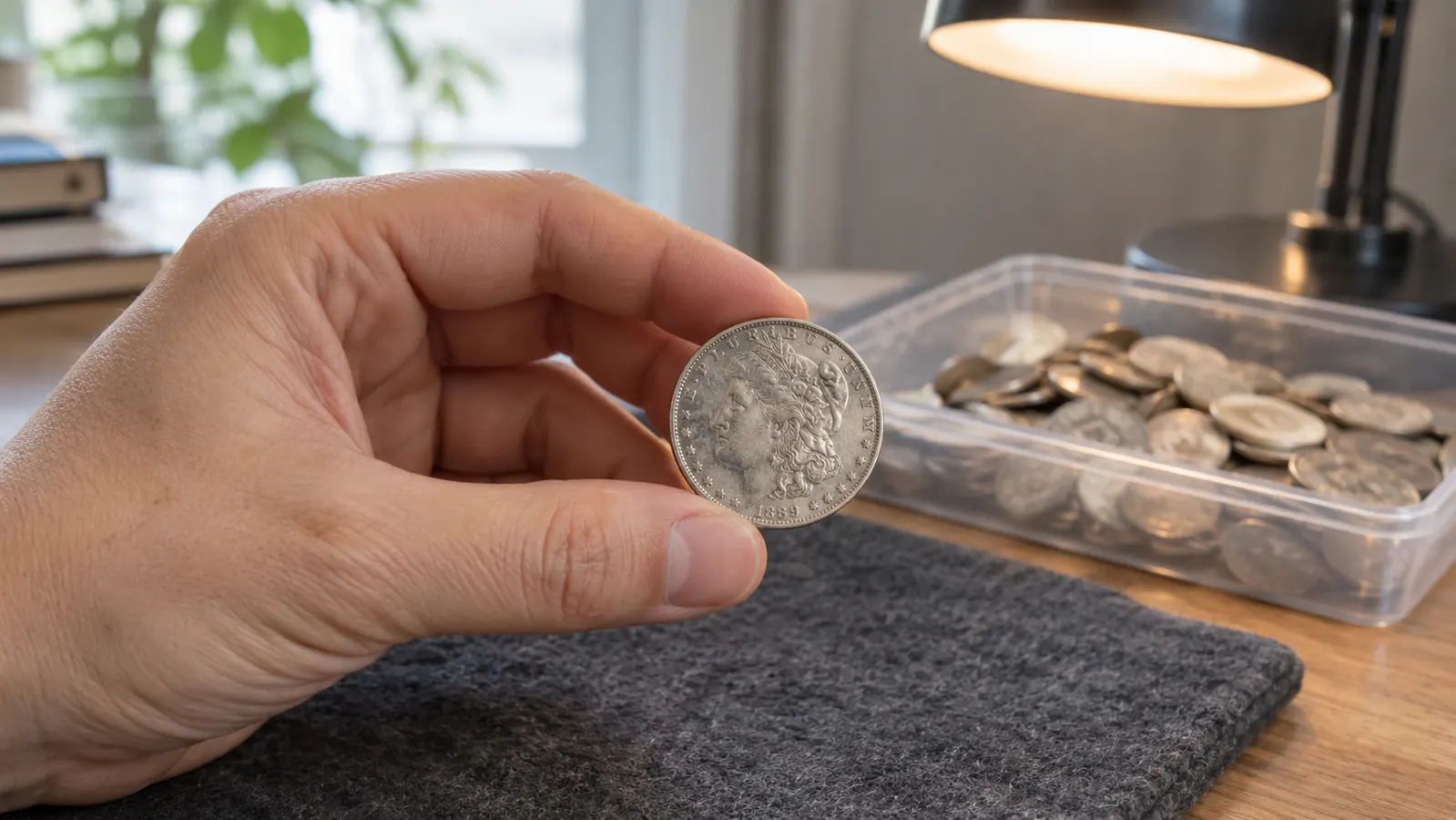
There is a middle ground, and most of my handling lives there. A circulated coin that I am checking for a variety or a date, one that goes back into the tube in a minute, gets bare hands and a felt pad. I pick it up by the rim, I look, I set it down. That coin has already survived sixty years of pockets and parking meters. My thumb for fifteen seconds is not the deciding factor in its life. The gloves come out when the coin is uncirculated, when it is going into a holder, or when I am going to be at the desk for an hour and my hands will start to wander.
The overlap is also where the argument on both sides gets a little silly. A man who insists on gloves for a junk silver dime is not protecting anything except his own peace of mind, and a man who sneers at gloves has usually never watched a print settle onto a proof. I have been in both camps. What moved me was not an argument. It was pulling a quarter out of an old fold and seeing a print on the field that had been sitting there since before I was born. I still have that quarter in a flip in the top drawer, and every so often I take it out and look at the print just to remind myself why the box of gloves sits where it sits.
The Test I Run Before I Put a Glove On
Four questions, and they take about two seconds. Is the coin uncirculated, a proof, or silver I care about? Are my hands clean and dry? Am I going to hold the coin for more than a few seconds, or set it on the felt and leave it there? And is there food anywhere near the desk? If the first answer is yes, the glove goes on. If the first answer is no and the last answer is no, I use bare hands and I do not lose any sleep over it.
That last question is not a joke. I once watched a grown man eat a sandwich over an open tray of Morgan dollars at a club meeting. He was not a careless person. He was hungry and thinking about something else, which is how most coin damage really happens. The glove helps with that because it interrupts the loop. It is a small speed bump between your hand and your mouth, and a small speed bump is all some of us need.
One practical note on the second question, because it trips people up. Clean and dry means clean and dry. If I have been out in the yard or the garage, my hands are not clean in the sense that matters, and washing them once with ordinary soap and drying them on a towel is enough. Lotion is the thing to watch. If you have lotion on your hands, the glove is not saving you, because the glove picks up the lotion and then the glove is on the coin. On the days my hands are cracked from the cold, I put the lotion on in the morning and I do not handle anything uncirculated until the next day. That is not a hardship. It just means the coin waits a day, and the coin does not mind waiting.
What I Liked
- Keeps skin oils and salts off the surface while you are working
- Twelve pairs to a pack, so a clean one is always within reach
- Washable and reusable in a mesh bag
- Thin enough at 0.15 inches that you can still feel a rim
- Size large, 9.2 inches, and it fits most adult hands
Where It Falls Short
- Fabric bunches at the fingertips until it has been washed a few times
- Dulls the feel enough that you take it off to grade
- A new pair can shed a fiber onto a mirrored field
- One size only, so it will be loose on small hands
Who Should Buy Which
Buy the Zealor gloves if you keep anything uncirculated, if you are putting coins into holders or albums, or if you handle silver dollars with any regularity. Twelve pairs is enough that you can keep a clean set in the coin room, a set in the safe deposit box and a set in the case you take to shows, and still have spares when the laundry piles up. I keep three pairs in the coin room, two in the show case and the rest in the drawer with the holders, and I have not run out yet. If you only sort pocket change and fill the occasional folder with circulated cents, clean bare hands are fine, and I would rather you put your money toward a decent felt pad and a loupe first. Neither the gloves nor the pad will make a coin worth more. They will just keep you from being the reason it is worth less, and that is the only claim I am willing to make.
Twelve pairs, one mesh bag, and one less thing to think about
Zealor cotton gloves in size large, 9.2 inches, cotton and polyester, washable and reusable. Keep a clean pair on the desk and put your hands somewhere else while the coin is out.
Amazon Check Today's Price on Amazon →